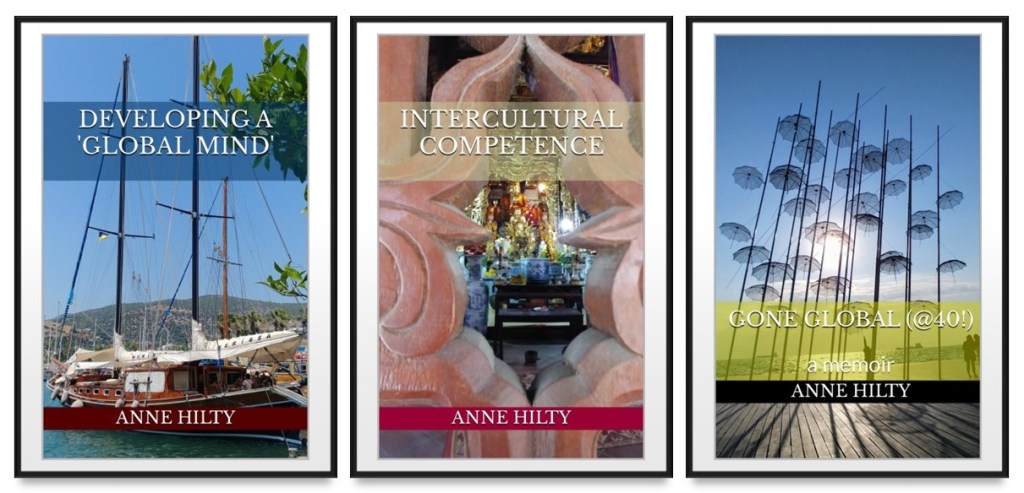
[Introduction to, Developing a ‘Global Mind’, ©2023]
What does it mean to be a global citizen?
That phrase is freely used, its meaning less than clear. Does it mean that you’re aware of world news and global concerns? That you have empathy for the world’s people? That you’re not a fan of national borders? That you’re cross-culturally aware and have a deep appreciation for cultures beyond your own? That you find ways to contribute to the greater, the global, good?
Yes. All that, and more.
I am a global citizen. I say that with some confidence in this, my 60th year of life, living abroad now for nearly 20 years in a series of countries – and hoping for (at least!) 20 years more, having traveled to more than 100 countries to meet their people and better understand their cultures. I’ve embraced a global mindset since childhood, the world as my home. But more on that later.
This ‘citizen of the world’ concept, of developing one’s global consciousness, is a lifelong endeavor. One doesn’t become a global citizen overnight; there’s no test (and no passport). Rather, as in any other area of personal development, we gain knowledge, experience, insight, and empathy that must be continually cultivated throughout our lifetime. And we engage, engage, engage.
United Planet, a program based in Boston which provides volunteer opportunities abroad as well as virtual, identifies 5 pillars of global citizenship: global understanding, relational diplomacy (“building relationships for a better world”), academic and professional competence, global leadership, and civic engagement.
The basic steps to your ‘global mind’ are this: we first gain deeper understanding of our own culture, so that we can better share it with others – and so we may learn to recognize our ethnocentrism and stereotyping as they arise. We learn to embrace cultures other than, and often very different from, our own, and to extend value to all cultures (though not always all cultural habits – as human rights can always be improved in any society), to increase our capacity for empathy and to deeply sense our interconnectedness with all of humanity.
And: we make an effort to develop a basic understanding of the world – its systems, its major events in history, its current challenges. We discover how we can get involved, not only caring for the world beyond our own national borders but taking responsibility and contributing to the greater good.
Most of all: being a citizen of the world begins as a mindset, but morphs into action. As a global citizen we understand our interconnectedness to all of humanity, the essential meaninglessness of borders, and our rights and responsibilities toward the global community of which we are a member.
A number of education programs for global citizenship now exist – which is very good news indeed for this complex world of ours. According to the UN, such education is based on the nurturing of respect for all as we develop our sense of belonging to the common human family, and to become increasingly responsible for and actively involved in that world community. IDEAS, an organization located in Scotland, identifies themes of global citizenship as “global interdependence, diversity of identities and cultures, sustainable development, peace and conflict and inequities of power, resources and respect.”
Back to my personal path to global citizenship, for a moment.
I spent the majority of my first 40 years of life in New York, one of the world’s most diverse cities – home to the UN, for 3 centuries the country’s primary immigration point, and with more than 800 languages. You might say I was surrounded by an organic global consciousness – even as the US has long been identified as one of the world’s more insular nations.
For 25 of those years, I was an activist for a range of concerns: gender equality, environmental protection, eradication of racism and homophobia, universal healthcare, ethical treatment of animals, and more. I read voraciously, consumed world news, paid careful attention to the actions of my government, worked in healthcare and education.
At the age of 40 I went global. As it were. I flung myself into the world, a semi-nomadic with periodic homes in successive countries – and for a few truly nomadic periods, no home at all but moving continually from place to place, specifically to develop my sense of the world and its cultures. Twenty years later and I’m still at it, having lived full-time in 4 countries and part-time in 4 more, with long stays in another six and cultural study in 113 countries to date.
My path to global citizenship has followed a breadth-depth-praxis framework. My first 20 years of adulthood were all about breadth: national engagement for a range of causes while educating myself to the world’s concerns. These past 2 decades have been about depth: living abroad and traveling widely, deepening my knowledge and engaging with the global community to the extent possible. Praxis will define my next 20 years (should I be so fortunate), as I continue my global life and engagement: practical application in sharing all that I’ve learned and experienced with global citizens around the world, through books and articles, online courses, and mentoring.
Being globally-minded doesn’t actually require travel or living abroad, though it helps; there are numerous ways to develop our understanding of the world and its cultural kaleidoscope. Getting to know people of other cultures is a crucial component, however, and we can also do this in highly diverse cities such as my New York, and of course, in a myriad of ways online. We’ll explore all of this together.
About this book: I was visiting professor for a year at a university on Korea’s largest island, Jeju. (I’d lived on the island for a few years previously, and a few more in Seoul, the nation’s capital.) There I designed several intercultural / multicultural courses, singularly popular as both Korean and international students were eager to know the world and develop their global citizenship. This book has been modified from one such course (its mate in the series, Intercultural Competency, from another).
Introductory in nature, this book serves as a guide especially for those who are still early in their development of global citizenship; it will provide the reader with a framework for self-education and development as a global citizen, with an overview of the world’s issues today. Naturally, this topic is ever-evolving, and a lifelong quest; Developing a ‘Global Mind’, therefore, is not a comprehensive textbook but rather a primer: a mentor to point you in the right direction. In the spirit of personal empowerment and responsibility…this task is ultimately your own.
Each chapter begins with a key question, explores that a bit, then brings in real-world applications and finally provides exercises by which you can integrate the concept into your own life. (There might even be a few stories along the way.) I recommend that you make use of both the exercises and link to further reading at the end of each chapter, in order to truly enhance your experience.
Remember, we’re evolving our ‘global mind’, and while this is in part a choice and a perspective that you can simply adopt, true personal development takes time, effort, and deep thinking. We can’t just read a book and visit another country then proclaim ourselves a ‘citizen of the world’, after all. It requires a lifetime to grow that consciousness well.
And what a lifetime of adventure that will be! Even if you never leave your own country, I can promise you: by finding as many ways as possible to embrace the world and its people, by thinking well outside of your own country’s borders and deeply about the world’s concerns, and by getting involved and applying your efforts in some form of contribution to the betterment of humanity and our shared community, you will have a most fascinating life indeed.
See you out there.
 Anne Hilty, PhD