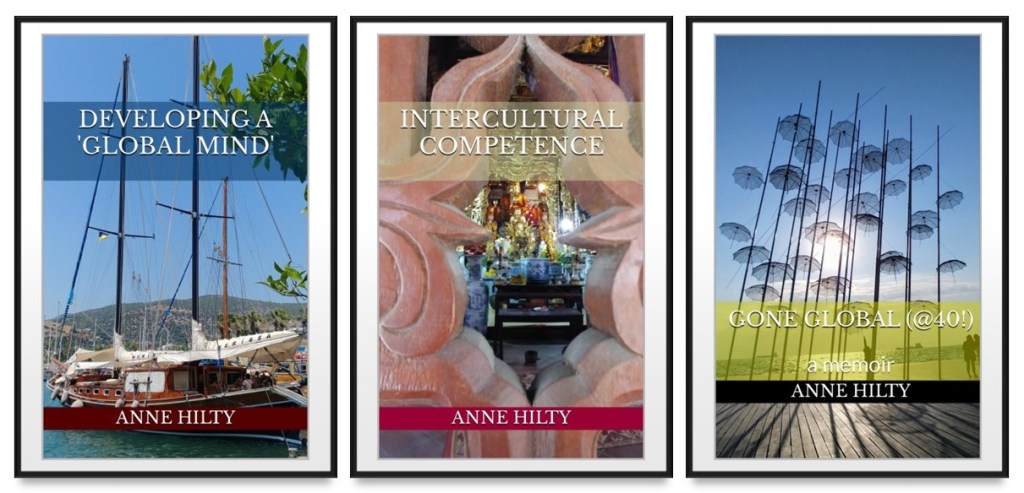
[Prologue to, Gone Global (@40!): a memoir, ©2023]
At the age of 40, I asked myself a dangerous question: What’s next? A psychologist and complementary medicine practitioner, with a newly minted PhD, private practice in New York, and hospital appointment, the logical answer was another 20-year addition to that career — in other words, more of the same, of this very nice life.
And yet—
Within 6 months of asking myself that question, I’d sold my clinic, resigned my hospital position, and moved to Boston to teach at university — knowing that this wasn’t a long-term move but a temporary adventure. Another 6 months, and I found myself on the other side of the world, living and working in Seoul, South Korea. Now, more than 18 years and 4 countries of residence later, with cultural research in 113 countries and territories across 6 continents and an identity transformation both personal and professional, I’m still living abroad – about to enter elderhood, with no intention of ending the adventure anytime soon.
This is my story.
**
Inspiration for this handmade life has come in many forms. One of the intrepid female travelers who most inspired my launch into nomadic life was Rita Golden Gelman, author of Tales of a Female Nomad: Living Large in the World (©2002). Reading her book proved to be pivotal for me; I’d turned 40 in November 2003 (with a seaside catered affair for 65 guests), finally finished my doctoral dissertation in April of the following year – 9 years in the making, and by May was wrestling with my ‘what’s next?’ inner turmoil when I discovered, and devoured, her book. Rita had a life-changing moment at age 47 when she asked herself that same question – and determined that she was going to live her dream, traveling and learning about the world and its peoples. She set out on her global adventure at age 48 and, until 2019 and age 81, remained nomadic with no fixed address. And while I didn’t set out to replicate her style, she’s remained an inspiration to me, and countless others, through the years.
Ultimately, I came to realize that the answer to my existential question was that, above all, I wanted to be free, at-large in the world.
For a successful migration, anthropologists tell us, there needs to be a ‘push’ and also a ‘pull’ – a reason to leave, and a reason to arrive. The push for me was both political and sociocultural. My home country was becoming increasingly politically divided; social causes I’d fought for throughout my adult life were more hotly debated than ever. The 911 terror attack in my city was a shock and a trauma, and in its aftermath, many red flags emerged as to the future steps of the government and direction of the nation. By early 2003 we were engaged in the highly suspect war in Iraq – and a year later, the sitting president was reelected. While I’d already taken steps to leave the country, that telling – and chilling – moment was the final lock on my decision. (The election of Trump some years later would add several more locks to my resolve.) Socioculturally, though I’ll skip the details, it can be said that America and I had long been ill-suited to one another.
The pull was equally multi-layered. Like Rita, I too had longed to embrace a global lifestyle; New York had provided me with a powerful lesson in cultural diversity and the global community, while in my recently concluded doctoral program, the courses that had excited me the most were those such as cultural psychology and cross-cultural understanding. The traveling I’d undertaken to this point, some rather exotic and unique, had only given me the urge for much more. Now, more than anything I wanted to roam the world, meet its peoples, have an astonishing array of experiences, learn as much as possible, and discover a myriad of ways to be a global citizen.
I was always headed for Asia.
In New York I’d been surrounded by a host of cultures, including one of the world’s larger Chinatowns and substantial Korean and Indian communities; Asians in fact are one of the largest minorities in the city, representing 30 ethnic groups and more than 50 languages. I was certified and licensed in traditional Chinese medicine, along with several other Asian healing arts. My master’s degree in transpersonal psychology had included coursework in East Asian philosophy and psychology. And I held long-term interests in shamanism (with its origins in Eastern Siberia), Buddhism, and Daoism.
But first: sacrifice was required. (It always is.)
I wasn’t married or in a relationship at that time, nor had (nor wanted) children – so that part of my decision was easy. And while I sincerely loved my professional life and didn’t want to abandon it, it was also an anchor; the rigor of my clinical schedule and the uniqueness of my work meant that I could never be away for more than a few days at a time – so, a choice had to be made.
The process of letting go is also multi-layered. I knew that relationships with family members and friends were going to change, as we wouldn’t see one another often; too, as they wouldn’t relate to my newfound global life, a chasm would open between us. I didn’t yet know which parts of my professional life I could take with me, perhaps to apply in new ways – though many aspects, it was clear, were going to be left behind forever.
I was also divesting of my personal belongings; nothing was going into storage as I had no plan of return. I’ve always valued experience over material goods, yet I’d accumulated 20+ adult years of trappings to sell, rehome, donate: artwork, a classical music collection, hundreds of books, a car, furnishings. (The day that I, a passionate cook and dinner party host, sold the entire contents of my kitchen to a young woman newly moved into her first apartment, who hadn’t yet learned to cook, was painful indeed.)
Ultimately, these were just things, no matter what they symbolized or how much I valued them. Letting them go, layer by layer, was an increasingly cathartic process. And when I was done, and found myself at JFK International Airport with 2 pieces of luggage containing all my remaining possessions, I’d already achieved a fair measure of that freedom I sought. I was floating. I could have flown on my own, no aircraft required. (The 3am layover in Anchorage, however, during which, in a bit of a stupor from the sleeping pill I’d taken, I came face to face with a taxidermized polar bear standing on its hind legs, did sufficiently shock me back down to earth.)
Just 3 weeks before my scheduled departure, the 26 December 2004 Indian Ocean tsunami disaster occurred, killing more than 200,000 people in 14 countries. Though this was far from Northeast Asia where I was heading, it did mean that Asia was very much in the world’s sights, and hearts, at that time.
I left the US for Seoul in mid-January 2005. It’s August 2023 as I write and I’ve had full-time residences in Korea, Hong Kong, UK, and (now) Türkiye, part-time (seasonal) in Thailand, Greece, and Italy (and also Türkiye, before the pandemic compelled me to full-time residency again), and extended stays in Brazil, Spain, Iceland, Ireland, Serbia, and South Africa.
There have been…
shamans and sacrifice in Siberia, orisha (and a remarkable nightclub) in Havana, a Muslim-Christian wedding in Cote d’Ivoire, a train crossing of the Gobi Desert, Tunisia’s delightful Sidi Bou Saïd, the discovery of Mennonites in Bolivia, road crossing and fake phone chat in Cairo, that night at that fetish club in Paris, feminist art in Quito, Ramallah – and a challenging West Bank entry, Auschwitz, townships in Cape Town, my sweet little island of Antigoni, medina and nightclubs in Marrakech, live octopus consumption in Seoul, pagans and healers in Iceland, language immersion in Spain, street art in Sao Paulo, cycling through Bang Kachao, shamanist ritual on a boat in the Yellow Sea, ‘green ocean’ and ancient cultures in Mardin, white nights in St Petersburg (and Iceland – and aurora borealis at 40,000ft), sea goddess temples and dragon boat races in HK, haenyeo school and olle trekking on Jeju, genocide and gender equality in Rwanda, Korean border during a nuclear crisis – and so very many more.
Some of these I’ll tell you, and maybe more, though which ones, I haven’t decided yet.
And so, this book. Largely memoir with a great deal of storytelling, neither instruction manual nor quite travelogue, it is but a glimpse into nomadic, and handmade, life…and possibly, just a wee bit inspirational.
“All journeys have secret destinations of which the traveler is unaware.” [Martin Buber]
Shall we begin?
 Anne Hilty, PhD