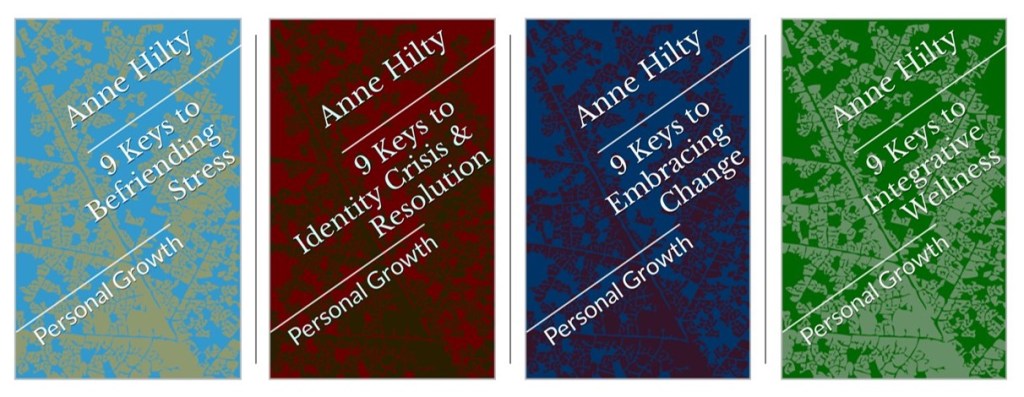
[Introduction to, 9 Keys to Identity Crisis & Resolution, ©2023]
Ah, identity crises. I know something about that.
Imagine going through life, knowing more or less who you are, comfortable with that, an identity like a prism with many facets, some of them contextually- or role-based, goal-driven and purpose-oriented, content with life: home, job, relationships, self. Then, one day: you wake up and everything has changed.
Or: nothing has changed, except that you don’t know who you are anymore. Amnesia, without the loss of memory.
It may not have happened suddenly, though some surely do; it may have snuck in gradually, quietly, and then you suddenly became aware that the chasm was there, and swiftly widening. You feel confused, anxious, irritable, insecure, and despite your many previous years of independence, confidence, clarity…you’re embarrassed to say it aloud, but you long for someone to just tell you who to be now, and you’ll do that.
Instead, it’s not nearly that simple: you’ve been invited, or compelled, by the Fates to reframe your life and yourself, to either reboot to an earlier version of you – or to enter a cocoon and emerge transformed.
I have undergone two major shifts in identity…and am now embarking on a third.
Late adolescence, the time we best recognize for a focus on establishing one’s identity, and trying various such on for size, was my first. My family was of an all-consuming, ultra-conservative, fundamentalist Christian religion – my father our minister, for several of my childhood years, while for several more we belonged to mega-churches, and for a few I was sent to private Christian school – and by my mid-teens I’d begun to seriously question whether this belief system and lifestyle was for me. Naturally, this precipitated an upheaval in family relationships, as I became increasingly certain that I was not to simply become a natural product of my upbringing but that my truth was elsewhere.
By age 16, I was questioning; at 18, I was certain, and by age 19, I’d moved out to live independently – and, secularly. (I might also mention a lesser wave just a few years later, when I underwent a modification of my sexual identity.)
Second such transition: age 40. Classic, I know. (And me, a psychologist.) It was the perfect storm: not only was I turning 40, but I’d also already begun an early perimenopause, that most biological transition for women, and to top it off: I was in the final stage of a PhD that had been 9 years in the making. And so I began asking myself, even as I had built a solid career as a multidisciplinary health provider in my own clinic, with an appointment at a nearby hospital: what do I still want to do? who do I want to be, to become? It wasn’t academia – while its ivory tower / think-tank ideal appealed greatly, I knew this wasn’t the reality – yet I was about to have this shiny terminal degree, and what did I want to do with it? I looked around and realized that my very nice life was on course to simply continue for the next 20 years or so…and that was too much sameness for me.
I had always been keenly interested in Eastern forms of philosophy, in cross-cultural psychology, in the concept of global citizenship; within one year of my questioning, my practice now closed, positions resigned, clinic sold, I found myself in Northeast Asia, living in Seoul. I had launched myself, for a multitude of reasons, into a global lifestyle – and am still very much out in the world today, 20 years later.
Only, the identity reformation was just beginning. I’d asked myself a life-changing question that led to a major upheaval…and in living abroad, in a series of cultures not my own and without the psychosocial support structure of old, I’d entered the crucible. In particular, having identified with my profession and as a healer for so long (I’d begun working in health care at 16 years of age), I’d essentially thrown it all away. It took some painful years, exciting as it was to be experiencing so much newness, before I felt like I’d morphed into a new version of myself.
Incendiary.
Third identity transformation – as my third-third of life, my third act, or as the French say, le troisième âge, swiftly approaches. I have asked myself a question similar to those of 2 decades, and 4+ decades, ago: what more, or differently, do I want? More importantly, who do I want to be, and how do I wish to enter and conduct myself, in this new stage: elderhood? It’s a fascinating experience to approach this new transformation as consciously as possible, including an upcoming book on the process, to be called, Chrysalis to Cronehood.
And so: identity dis- and reintegration.
“No death, no doom, no anguish can arouse the surpassing despair which flows from a loss of identity.” [H.P. Lovecraft]
So, what precisely is identity?
Several domains of identity have been described: personality, gender, sexual orientation, ideological (which can take a multitude of sub-identities, political and religious just for a start), cultural, occupational / professional. We aren’t exactly different in each context – or are we? The very concept of identity, it turns out, is quite differently perceived in individualist versus collectivist societies; the individualist view holds that one’s core identity remains a constant even as the context around us changes, influencing and temporarily altering how we behave and even how we think, while a collectivist or group-oriented society (the vast majority of the world) sees identity as utterly contextually driven, that while we may have a few key personality traits, our identity shifts according to our setting. Both, I would argue, ring true, and so ‘identity’ either falls somewhere in between – or is an illusion altogether, which both Buddhism and some areas of western psychology would support.
Sometime during my first year in Seoul, I asked a Korean friend in her early 30s what she thought about something – to me a very simple question of opinion. She paused, then said, “When someone asks me what I think – and it’s usually a westerner – I don’t know how to answer, because I was never taught to think for or about myself.” My eyes were surely opened that day.
Then, what is the crisis of identity?
Actually, we can have identity confusion, or crisis. In the first, our identity was never well developed to begin with; we may have had an overbearing parent, arrested development due to a major life event, or cognitive / developmental challenges which are either congenital or due to injury or illness. In another scenario, the person who belongs to 2 or more ethnic or cultural groups – with parents from 2 differing identities, for example, or being born / growing up in a culture different from that of your parents, can also create identity confusion. This not knowing who you are may result in a vulnerability to others, as one is more easily influenced; it can also lead to negative self-perception, low self-esteem, minimal self-worth, and even mental health issues.
The crisis, instead, comes to the individual with a relatively clear sense of self who experiences a major event (e.g., violence, loss, natural disaster) that proves destabilizing. One may question one’s sense of meaning in life, one’s beliefs and values, one’s core personality (“I don’t know who I am anymore”), and have difficulty in relationships. Anxiety, depression, indecisiveness, and abuse of alcohol or substances may also result from this profound sense of discomfort.
Such intense reassessment or reframing of self, however, while almost always deeply disturbing and even painful, is also an opportunity for rebooting, for transformation. Though a crisis, if it’s approached consciously (often difficult to do in the midst of pain, which may need to first subside a bit), there is a chance for immense personal growth. Hence, the nature of this book.
Again: very different in collectivist cultures wherein the idea of ‘self’ is secondary to that of group identity and cohesion, though we must also point out that individualist-collectivist is a continuum, with many degrees of same and few pure forms of either.
The crisis of identity was first described in Erikson’s 8-stage model of developmental psychology across the lifespan; conflict between identity and role confusion was seen as the developmental task of adolescence, though Erikson also felt that identity could again shift at any later point in life. He further identified 2 aspects to the process of identity (re)establishment: formation, followed by integration. Marcia, in his model of identity status, referred to Erikson’s processes of identity formation and integration as an exploration of various identities followed by commitment to one in particular. He identified 4 possible outcomes: foreclosure, in which one commits to an identity without exploration (e.g., following the religion or politics of one’s childhood); diffusion, with no particular exploration or commitment, and no true sense of identity or belonging; moratorium, in which one has suspended the commitment to an identity while in an active phase of exploration (e.g., the teenager or young adult who is trying on various identities); and, achievement, which includes a process of exploration and an ultimate commitment.
But what causes an identity crisis?
Some are normal, expected, even biological – that of the adolescent as mentioned, a period in which identity formation separate from that of childhood and family is the primary psychological task, in preparation for independent adulthood; midlife, when one’s age itself as well as the beginning of age-related biological changes can trigger a questioning of identity, and a sense of needing to make changes while there is still time. The former is triggered in part by the sudden influx of sex hormones, while the latter is often associated with a decline in same – well worth noting, I think, as our body chemistry is prompting psychological change, and in midlife we can feel just as confused and emotionally labile (men as well as women) as we did when teenagers. We may also note the toddler who, while not a change in identity so much as a first formation, is triggered by neurochemistry to a realization that he/she is a separate person from, rather than an extension of, his/her parents. The other life-stage identity reorganization comes in early elder years, again largely driven by biology, in which we’re compelled to face our mortality and to reassess what we want from life before time runs out.
There are many other causes of identity crisis or destabilization. I mentioned earlier the act of going abroad and living in a culture not one’s own, without any familiar support structures in place; in the excitement of the new experience, many don’t anticipate just how destabilizing to the psyche it can be as, for example, old mental illness resurfaces or addiction becomes a very real possibility. Any major change can do the same: alterations in relationship or job, new parenthood or newly empty nest, death of a loved one, violence or other trauma including natural disaster – or a pandemic, physical or mental health issues or bodily changes, early sobriety, coming to terms with one’s gender or sexual identity.
Some of the signs of identity issues include a feeling of insecurity, with loss of self-esteem and self-efficacy; generalized aimlessness or feeling lost and indecisive; questioning one’s purpose, values, beliefs, or interests; emotional instability and/or feelings of stagnation (being ‘stuck’); and, imposter syndrome (if only others knew how I really feel / who I am / that I’m not capable or good enough). There may also be somatic symptoms – your body doesn’t feel right, you’ve new aches and pains, you get sick more easily.
Most of all, you find yourself preoccupied with self-directed questions. Who am I, really? Who is this person, this me, that I no longer recognize? What’s my role in society / purpose in life? What are my values, what do I believe? What am I passionate about? Who do I want to become? In midlife, when not connected to other major change, the questions are often more about time running out: Should I be enjoying my life more, trying new things? Do I like the way my life has unfolded, and is there still time to change it? Is it too late / Do I still have time to …? And as our elder years approach: Have I done all that I wanted to do? What legacy do I want to leave behind? What do I want from these elder years? What are my fears? Who am I becoming? (Who is that old person in the mirror?)
Asking these questions, actively seeking answers, however disturbing or painful, is crisis – and therefore, opportunity for change, into a new version of oneself. Not or no longer asking such questions, but generally feeling negative or hopeless about them, is a sign of depression and needs addressing.
How do we cope with identity crisis? How do we get to the other side, identity reorganization, stabilization? And one giant step further: how can we embrace this as an opportunity for transformation?
In any destabilization, we seek means of grounding ourselves; we focus on things that aren’t changing, that remain stable, often in our meaning and values and perhaps in our relationships, including that which we have with the natural world. In order to cope with profound change, then, we need a stabilizing factor onto which we can hold.
We also need a basis of emotional intelligence – that we know ourselves emotionally, can recognize what we’re feeling, and have skills to regulate our emotions and remain objective, rather than being pummeled by our emotional whirlwind – to be the eye of the storm. We need mental fitness and self-care, the support of others and sometimes of professionals, the skill of reframing in which we see things through a different perspective, and an evaluation of our locus of control – whether external or internal, working toward the latter so that we’re less buffeted by what goes on around us, or the influence of others. More on all of this coming soon.
This leads us, then, to our 9 keys. In this book, we’ll be looking at: (1) introspection and insight; (2) emotional regulation: mindfulness; (3) growth mindset; (4) mind shift: CBT/REBT; (5) flexibility: ACT; (6) soul loss: shamanism; (7) ego death: transcendence; (8) reinforcement: ritual; and, (9) true self: nature. And, a bonus chapter: self-care and support system.
Shall we begin?
 Anne Hilty, PhD