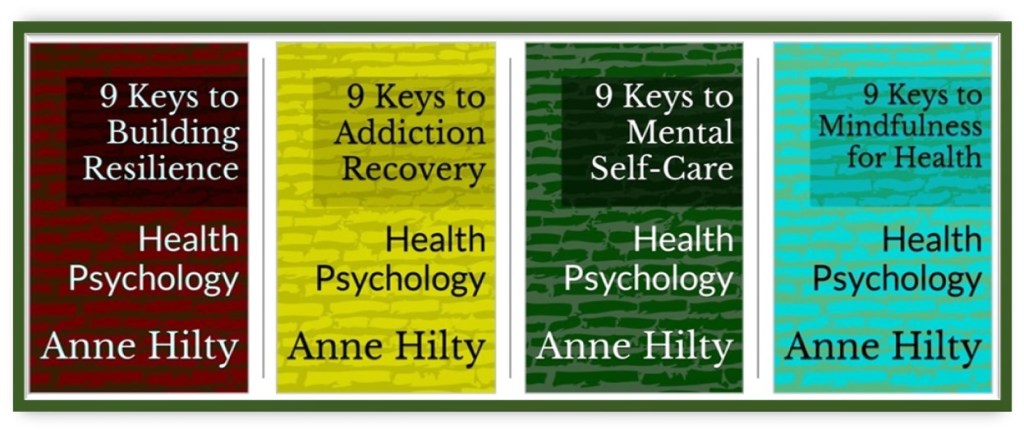
[Introduction to, 9 Keys to Mental Self-Care: Health Psychology, ©2023]
Mental wellbeing.
In today’s world, this can seem a luxury. We live at a breathtaking pace, with expectations of 24-hour connectivity and instantaneous response – and a number of ‘slow-down’ movements as forms of protest. There’s much to worry about, and a generally combative atmosphere.
So how can we support our mental wellbeing? Is it possible, when the world at worst seems on fire, and at best is, well, rather intense? Isn’t that just ignoring all that’s wrong, keeping our heads buried in the sand?
It’s not only possible to maintain mental wellbeing; in today’s world it’s essential that we do so. “If you can keep your head when all about you…” (with a tip of the hat to Kipling).
But how?
First, a disclaimer. If you’re in need of psychological care, or already in treatment, these practices aren’t meant as a replacement – but, they can be an enhancement. If you’ve questions about your current mental state, an assessment with a professional may be a good next step.
And: a disclaimer of a very different sort. While this book is focused on mental self-care, I don’t actually believe that there’s any separation of mind and body. In fact, we’ll take a biopsychosocial approach, or nondualist, as the Buddhists would have it (mindfulness being one of our 9 keys): body and mind are one, entirely integrated and all part of one whole, glorious person. You.
So as we focus on mental care, we’ll begin with somatic (body) care in view of this nonseparation — and all within the health psychology framework, with its biopsychosocial model of health and humanity and emphasis on a healthy and supportive lifestyle. (More on this soon.)
The term ‘wellbeing’ gets widely used, to mean many different things. Two types are found in the scientific research: subjective wellbeing, feeling generally okay and content with your life, and psychological wellbeing, specifically mental and emotional strength and capability.
Psychological wellbeing includes having a sense of purpose and meaning in one’s life, good relationships with others, a general feeling of autonomy or self-sufficiency, overall self-acceptance, and a focus on personal growth. Mental health, then, is an integration of psychological, emotional, and social wellbeing. And with psychological wellbeing, the science is clear: we live healthier and longer, with a higher quality of life, contentment, and happiness.
Wellbeing.
In a review of 38 empirical studies conducted 2009-2019 in Australia (Heinsch et al., 2022), protective factors for adult mental health were identified. Such factors were in broad categories of individual attributes, social support, healthy lifestyle, and creative arts – and we’ll see all of these and more in our 9 keys.
Wellbeing science is broadening, as our understanding of what contributes to wellbeing continues to grow (Kemp & Edwards, 2022). Today, the ecopsychology field supports our nature connectedness as an essential component of wellbeing, something our ancestors knew well but in our rush to modernity, we’ve all but lost. The field of positive psychology has also contributed greatly to the concept of wellbeing, in its overarching focus on mental health and the areas and attributes that contribute to it, as has acceptance and commitment therapy, with its emphasis on psychological flexibility.
Let’s return to health psychology now. As mentioned, this specialty embraces the biopsychosocial model of what it means to be a whole human being; many health psychologists include the aspect of spiritual health as well, in an overarching concept of meaning and purpose, which can be found not only via religion but also in sources such as nature, philosophy, and ethical living (Saad et al., 2017). Health psychologists typically work in a hospital or other clinical setting, helping people deal with their fears and resistance when newly diagnosed with a physical illness, for example, or in developing a healthier lifestyle for those struggling with mental illness (Bogucki et al., 2022) – in a firm belief that body and mind affect one another, for good and ill, and thus any treatment plan or general lifestyle approach must be all-inclusive.
What a disservice French philosopher Descartes, and the medical scientific community to follow, did to all of us in this false separation of body and mind; we aren’t just a heart or stomach, or depression or even psychosis, but are whole, integrated human beings – all parts of us in deep communication with one another. Medical science today, of course, is moving ever closer to this model – this return to our roots of nonduality, while indigenous forms of medicine throughout the world, and Asian philosophy in contrast to European, never separated the two.
Physical illness has mental components, and vice versa; even in the ‘somatization’ arena, in which one’s mental condition creates physical symptoms for which there’s no biological basis, this still doesn’t mean it’s only imagination; rather, the mind has contributed to physical illness which is now very real, and the reverse can also be true. Two examples: having to deal with a chronic illness is likely to bring anxiety and/or depression; anxiety and depression are just as likely to develop into physical symptoms such as hypertension or irritable bowel syndrome.
Thus, health psychologists typically have a strong biological background and are well familiar with human anatomy, physiology, and pathology. They bring their skills as a psychologist to bear on such issues as resilience, stress management and coping mechanisms, smoking cessation and other forms of addiction treatment, eating disorders, dealing with chronic illness, enhancing motivation for medical treatment regimens, and generally developing and embracing a healthier lifestyle (Hariharan, 2023). They embrace methods such as Motivational Interviewing or Acceptance and Commitment therapies, as well as positive psychology and the practice of mindfulness – and the applications of exercise, nutrition, and somatic therapies. Health psychology has quite a lot to say, then, about mental self-care.
So would any other branch or specialty of psychology, to be fair – but from the perspective of health psychology and its biopsychosocial (-spiritual) lens, the approach to mental self-care is especially comprehensive.
Let’s take a closer look at that idea of ‘lifestyle’ – a term with a range of meanings. While its popular use is one of engaging in health-promoting practices and avoiding behaviors that represent a health risk, Brivio et al. (2023) argue that this reduces the concept to the behavioral realm while minimizing psychological, identity, and life span aspects. In their review of health psychology research, they identified the ‘lifestyle’ term to have dimensions that are internal (personality, way of thinking, values, interests, and attitudes), external (behavior patterns; social position or status), and temporal (daily practices engaged). They propose that lifestyle as defined by health psychology, is “a system of meanings, attitudes, and values within which the subject acts, which define individual and collective models of health practices within social, historical, and cultural contexts.”
How’s that for comprehensive? In other words: we must consider the healthy lifestyle not only as what we do, but also how we think, who we are, and at what stage of life we find ourselves, alongside contributions of our family, society, and cultural background.
Health psychologists are closely focused on what motivates people to healthier behaviors – or stands in their way. Five health behaviors were analyzed in an extensive review of 633 studies (Perski et al., 2022), to identify psychological and contextual predictors of physical activity, nutrition, alcohol consumption, tobacco smoking, and sexual behavior. Two most common predictors overall were motivation and goals, versus negative emotional states, while social influence and social context / resources were also strongly noted. A total of 1,896 predictors of health behavior were identified.
Similarly, the health psychologist is keenly engaged in patient education about health concerns. In a mega-analysis of relevant research over the past 6 decades, including 40 previously conducted reviews representing 776 studies and 74,947 patients for a broad range of physical and mental conditions, Simonsmeier et al., (2022) demonstrated strong evidence for the effects of patient education on improved health behaviors. Specifically, educating people about their conditions significantly resulted in reduced medication, pain, and clinical visits, and improved outcomes in all areas: physiological, psychological, and functional.
Health psychology research focuses on this enhancement of individual health behavior, and has greatly informed the medical community in this area. In a review of how health psychology research translates into practice, Presseau et al. (2022) identified the impact of such research on practical application or health behavior change interventions, with wide potential for even greater influence. In one such application, a massive open online course [MOOC] on self-care was offered from March 2020 to January 2021 in conjunction with the global Covid pandemic (White et al., 2021). The study had an aim of participants’ health behavior promotion in areas of nutrition, physical activity, and mental health; significant increases in health behaviors were measured on pre-/post-test in outcomes of physical wellbeing, perceived stress, anxiety and depression, and self-efficacy.
Learning about health behaviors and lifestyle can go a long way, it would seem, toward motivation and personal application.
And so, in keeping with the principles and practices of health psychology, and a bio-psycho-socio-spiritual approach, we come to our 9 keys for mental self-care.
We’ll begin by looking at somatic care – how caring for our physical needs complements our mental wellbeing. We’ll look at exercise, nutrition, sleep, and somatic therapies, and how we can better engage these areas. We move from there to our natural home: nature itself, spending time immersed in nature, and the effects of nature connectedness on mental health.
From there, we explore complementary practices of gratitude and self-compassion, for a dual approach in our 3rd key; this leads us into mindfulness, with its practices of meditation and beyond. Expressive writing is next, as we look at how journal-writing and similar can support mental health, while creative engagement is our 6th key.
The power of ritual follows, whether religious or secular, for support of psychological wellbeing and personal growth. Our 8th key is social support, as we look at how important it is to mental wellbeing (for introverts, too!) and how we can better understand and enhance our social capital. And then we reach our final key: prosociality, or contributing to the greater good.
Shall we begin?
References:
Bogucki OE, Kacel EL, Schumann ME et al. (2022). Clinical health psychology in healthcare: Psychology’s contributions to the medical team. Journal of Interprofessional Education & Practice 100554. https://doi.org/10.1016/j.xjep.2022.100554
Brivio F, Viganò A, Paterna A et al. (2023). Narrative Review and Analysis of the Use of “Lifestyle” in Health Psychology. International Journal of Environmental Research and Public Health 20:5:4427. https://doi.org/10.3390/ijerph20054427
Hariharan, M. (2023). Evidence-Based Health Care: Contributions of Health Psychology. In, Health Psychology (pp. 3-24). Routledge India.
Heinsch M, Wells H, Sampson D et al. (2022). Protective factors for mental and psychological wellbeing in Australian adults: A review. Mental Health & Prevention 25:200192. https://doi.org/10.1016/j.mhp.2020.200192
Kemp AH and Edwards DJ (2022). Discussion: Broadening the Scope of Wellbeing Science. In: Kemp AH and Edwards DJ (eds), Broadening the Scope of Wellbeing Science. Palgrave Macmillan, Cham. https://doi.org/10.1007/978-3-031-18329-4_11
Perski O, Keller J, Kale D et al. (2022). Understanding health behaviours in context: A systematic review and meta-analysis of ecological momentary assessment studies of five key health behaviours. Health Psychology Review 16:4, 576-601. https://doi.org/10.1080/17437199.2022.2112258
Presseau J, Byrne-Davis LMT, Hotham S, et al. (2022). Enhancing the translation of health behaviour change research into practice: A selective conceptual review of the synergy between implementation science and health psychology. Health Psychology Review 16:1, 22-49. https://doi.org/10.1080/17437199.2020.1866638
Saad M, de Medeiros R, and Mosini AC (2017). Are We Ready for a True Biopsychosocial-Spiritual Model? The Many Meanings of “Spiritual”. Medicines 4:4, 79. https://doi.org/10.3390/medicines4040079
Simonsmeier BA, Flaig M, Simacek T et al. (2022). What sixty years of research says about the effectiveness of patient education on health: a second order meta-analysis. Health Psychology Review 16:3, 450-474. https://doi.org/10.1080/17437199.2021.1967184
White MA, Venkataraman A, Roehrig A et al. (2021). Evaluation of a Behavioral Self-care Intervention Administered through a Massive Open Online Course. American Journal of Health Education 52:4, 233-240. https://doi.org/10.1080/19325037.2021.1930616
 Anne Hilty, PhD