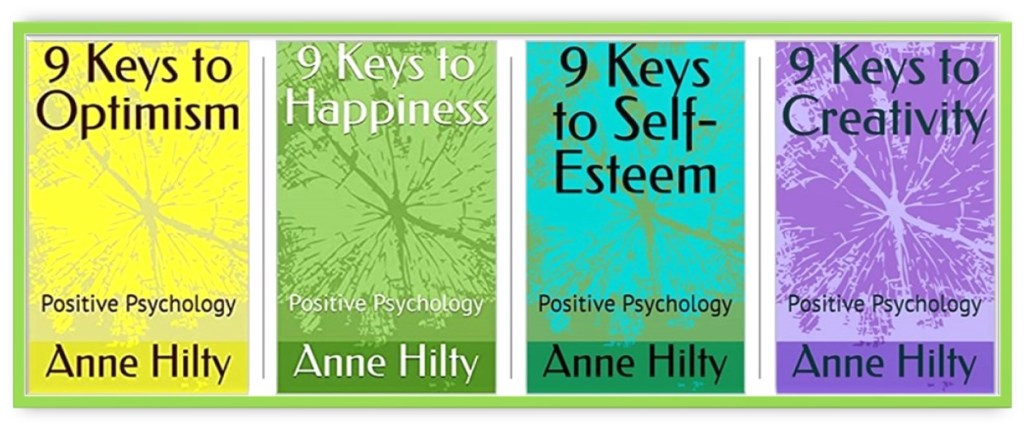
[Excerpted from, 9 Keys to Happiness: Positive Psychology ©2023]
Our third key to a pleasurable life can be found in paired concepts: savoring, and gratitude. These are often addressed separately, yet they bear a close relationship. When we truly savor the moments that bring us pleasure, contentment, happiness, it is an appreciation – a type of gratitude. This naturally also relates to our first key, focus and notice.
As I write this, sitting at my desk in front of a sunny urban apartment window in early spring, I see the herbs in my window boxes swaying in the breeze, hear the music of the windchimes that hang above the window, feel the warmth of the sun on my face, and smell the fresh sea air, as rainbows — from the prisms I’ve hung in the window – are dancing around me. Pure, simple happiness. And so, I savor this moment, give it space and time, don’t just notice and then return to my busy-ness but instead, pause to enjoy and reflect. String many of these moments together, and it’s a happy lifestyle, a pleasurable life. And I am deeply grateful.
In 2007, Bryant and Veroff published Savoring: A New Model of Positive Experience, which has prompted a good deal of research and brought ‘savoring’ into the core concepts of positive psychology. Just the word itself gives us an impression of its meaning, the feeling of the word being one of drawing out something pleasurable. In the introduction to their book, Bryant and Veroff defined ‘savoring’ as “the capacity to attend to, appreciate, and enhance the positive experiences in one’s life” (p. xi). In recent research, Bryant (2021) identified 10 strategies for savoring: sharing with others, memory building, self-congratulation, sensory-perceptual sharpening, comparing, absorption, behavioral expression, temporal awareness, counting blessings, and kill-joy thinking. These are perhaps all self-explanatory with the exception of the latter; kill-joy thinking is defined by Bryant as the technique of decreasing our interest in order to self-protect against disappointment — a form of savoring more typical in East Asian cultures, for example, in which life is being savored while desire for more is suppressed. In other words, we savor the moment by not giving in to our desire for more than what we have right now. In a recent study by Klibert et al. (2022), those engaged in savoring techniques reported increased positive emotions thereafter, greater than those utilizing other methods such as reminiscence or guided imagery.
Much has been written recently about gratitude. After a point, it seems like mere platitude instead. And yet, there is never enough that could be said about this practice in terms of its ability to generate happiness and overall wellbeing. In positive psychology, great attention is given to the regular practice of gratitude and its impact on happiness. A recent Harvard Medical School Healthbeat blog entry (August 14, 2021) reported that gratitude is “strongly and consistently associated with greater happiness,” enhancing a range of positive emotions as well as relationships, physical health, and resilience. In a study by Kardas et al. (2019) of optimism, hope, life satisfaction, and gratitude, the latter was the most predictive for wellbeing, though all were important. Gratitude was found to predict and thereby directly influence both hope and happiness, exceeding those of forgiveness, patience, and self-control, in a study by van Oyen Witvliet et al. (2019).
We can cultivate these mirroring attributes of savoring and gratitude. Savoring, like noticing or mindfulness, is taking some moments to stroke the cat or play with the dog instead of giving over completely to that deadline. It’s fully appreciating the food that we’re eating, bite by slow bite. And it’s reveling in our relationships, even those longstanding and often annoying ones, for it’s by our connectedness that we know ourselves to be truly alive. When we are grateful, rather than take any aspect of our lives for granted, life becomes an exponentially richer experience. We needn’t necessarily be grateful to a particular person or source, or to a deity if not religious; simply allowing one’s being to fill with the quality of gratitude is sufficient.
.
Exercises:
This key, then, has us savoring as many moments and acts as possible, much like we might savor a fine wine or a great meal — so many juicy moments in the course of an ordinary day. And by this savoring, we can allow gratitude to flow through us. Exercises for savoring require full attention, thus relate to mindfulness as earlier mentioned. An important element is to reduce or eliminate distractions, thereby to fully focus on the task, event, or activity before us.
Listen to music. Truly listen — not as background but sitting quietly, eyes closed, listening deeply. Eat a meal without the television, book, Internet, or any other object requiring your attention. If with a partner, friend, or family member, make an agreement to have a meal in silence, focusing on and fully enjoying the food itself. Soak in a bath, feeling the water on your skin, the warmth of it, the silkiness of whatever you may have added to the water. Stare into a candle flame and fully appreciate its beauty; the same goes for spring flowers blooming around us. Don’t just have a quick look; take time to truly notice and appreciate. Savor life, in all of its juiciness.
We can also savor a moment or an experience through reflection. Write about it in a journal. Make a video or audio recording. Gaze at photos of past experiences, deeply seeing them and recalling details, reexperiencing the moment. Tell a friend — and make it a good and detailed story. The savoring is in the details, and in experiencing the positive emotions fully — and again, and again.
Exercises for engendering gratitude include keeping a gratitude journal, stating our gratitude into the mirror as we look into our own eyes (far more powerful than it sounds), writing it on a small piece of paper or a bay leaf and then burning it as a prayer, focusing on what we’re grateful for while in meditation or during a walk in the woods — or a roll if you’re in a chair, and telling someone when you’re grateful for them. (Sending a text message to that effect is an easy way to raise our gratitude quotient; think how easy, yet meaningful, that can be.) We can begin each day in gratitude — on waking, grateful for a new day. Create a ‘gratitude jar’ or box, decorate it, place it prominently, feed it daily.
As a regular practice, savoring and gratitude bring a positive impact on immunity, lower stress response, and generally contribute to physical and mental health – and surely increase happiness.
.
References:
Bryant FB (2021). Current Progress and Future Directions for Theory and Research on Savoring. Frontiers in Psychology, 12:771698. https://doi.org/10.3389/fpsyg.2021.771698
Bryant FB and Veroff J (2007). Savoring: A new model of positive experience. Mahwah, NJ, US: Lawrence Erlbaum Associates.
Kardas F, Cam Z, Eskısu M et al. (2019). Gratitude, Hope, Optimism and Life Satisfaction as Predictors of Psychological Well-Being. Eurasian Journal of Educational Research, 19:82, 81-100.
Klibert JJ, Sturz BR, LeLeux-LaBarge K et al. (2022). Savoring Interventions Increase Positive Emotions After a Social-Evaluative Hassle. Frontiers in Psychology, 13:791040. https://doi.org/10.3389/fpsyg.2022.791040
Van Oyen Witvliet C, Richie FJ, Root Luna LM et al. (2019). Gratitude predicts hope and happiness: A two-study assessment of traits and states, The Journal of Positive Psychology, 14:3, 271-282, https://doi.org/10.1080/17439760.2018.1424924
 Anne Hilty, PhD