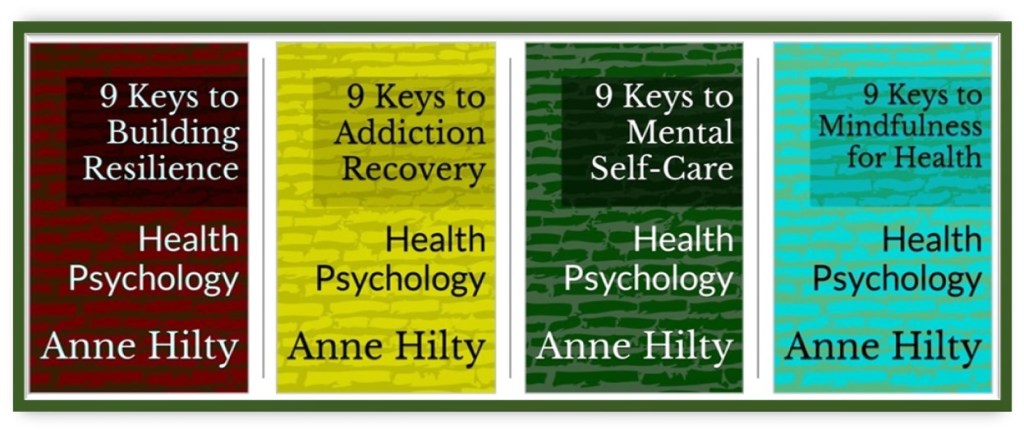
[Excerpted from, 9 Keys to Mental Self-Care: Health Psychology ©2023]
Gratitude and self-compassion are powerful mental health care.
Much has been written about gratitude. And while not quite the cure-all that some propose, it’s surprising just how therapeutic an attitude of appreciation can be.
When I awake each morning, I’m grateful for a new day, and a fresh start. I awake with the rising sun (yes, I’m a lark, rather than an owl), and I’m thankful for the sunrise, too. My little cat is typically curled up against me, and my heart overflows with gratitude.
All this, in the first 30 seconds of the day.
We can feel grateful for the smallest, yet exquisitely beautiful, things. A praying mantis recently landed on my shoulder and sat there for a short while, and I was filled with wonder at this extraordinary creature. As I’m writing this in late June, in my Istanbul apartment amid a densely urban environment, my desk faces a window outside of which is a clear blue sky and a window box of lavender and thyme, visited by bees, with mourning doves nested and cooing nearby. Sunbeams stream in onto my desk and tiny rainbows, from the prisms I’ve hung in the window, dance all around me – and I am consumed with gratitude.
Even when we’re dealing with difficulty, no matter how profound, and indeed, especially then, if we can notice and appreciate these tiny moments, it goes a long way to alleviate our troubled mind. In making a habit of gratitude, we infuse each day, and our lives, with these moments of beauty, and powerfully affect our health for the better.
Self-compassion is like that, too.
In the sense that we can also turn gratitude toward ourselves, not in an egotistical way but in a basic appreciation, we’re already engaged in self-compassion. I’m grateful that I awoke today, can get out of bed and prepare breakfast for myself, am able to be kind to others and a caring person – for example. Gratitude toward oneself is closely linked with self-acceptance, and self-compassion is the mediator, as demonstrated in an online survey study with 290 participants (Homan & Hosack, 2019).
In self-compassion we treat ourselves as we’d treat others and as we’d like for others to treat us, with less negativity and judgment, and more kindness and love. In this way, self-compassion is healing and nurturing; we give ourselves the positive emotions that we, and all humans, crave and require for good health.
Each time we show ourselves compassion, we’re telling our deep mind: you’re worthy of kindness, and of love. And each time, we’ve boosted our own mental health. This is a choice. While we may not always feel love and kindness toward ourselves, we can choose to do so, regularly, until we fully believe in our own worth.
There’s an inner critic in each of us. For some who may have grown up in a negative environment, that critic may be strong. For most of us, we’re too quick to judge ourselves as stupid or careless instead of simply a person who made a mistake. Self-compassion is the precise opposite of self-judgment.
Compassion. And gratitude. For good mental health.
Gratitude interventions have shown to increase positive mood, as one might expect, along with resilience and coping self-efficacy or belief in one’s capability for coping (Klibert et al., 2019). Gratitude has been studied in several forms, and in particular, expressed gratitude – giving voice to one’s appreciation, such as telling someone when you’re grateful for something they’ve done – has a significant effect on psychological wellbeing. In a review of 25 empirical studies totaling 6,745 participants (Kirca et al., 2023), expressed gratitude was shown to increase life satisfaction, positive mood, and happiness, all of which are wellbeing indicators.
We might translate this to our social media environments; while the current trend is increasingly for scrolling by, rather than engagement, a ‘like’ here, a ‘share’ there, or a positive comment are expressions of gratitude to the original poster – and a boost to your own wellbeing.
The development of secure attachment in childhood is also fostered by gratitude. In a 2-year longitudinal study of 157 children aged 9-12 years (Scott et al., 2021), trait gratitude was robustly linked with attachment and indirectly linked to decreased depression. Secure attachment is a strong contributor to psychological wellbeing.
Among veterans, a high-risk group for PTSD and other mental illness, gratitude is a protective factor. Using data from a US national veteran study, McGuire et al. (2021) demonstrated that gratitude decreased the current risk for PTSD, anxiety, and suicidal ideation, and the lifetime risk for developing PTSD, social phobia, depression, suicide attempt, and nicotine dependence. Higher gratitude was also associated with perceived social support, purpose in life, religion or spirituality, curiosity, and optimism, all indicators of psychological wellbeing.
Gratitude in the midst of adversity increases coping skills such as presence of meaning and emotion regulation, in turn contributing to positive mood, perseverance, resilience, and social connectedness, all of which enhance wellbeing (Kurian & Thomas, 2023). Among young adult survivors of sexual assault, gratitude and optimism were shown to decrease or even eliminate the link between PTSD and suicidal ideation (Kumar et al., 2022).
Neff (2023) delineates 6 components of self-compassion: emphasizing self-directed kindness, mindfulness, and a sense of one’s common humanity, while minimizing self-judgment, overidentification [with one’s mistakes or flaws], and isolation. On a review of the existing literature, she identifies a large number of self-compassion studies in which psychological and physical wellbeing are promoted, associations with weakness or self-indulgence dismissed, and multiple such interventions described.
Self-compassion contributes to mental health in non-cisgender and non-heterosexual populations, frequently marginalized and thus at increased risk for mental illness. A review of 21 studies totaling 6,573 participants (Carvalho & Guiomar, 2022) demonstrated greater degrees of self-compassion to be associated with decreased anxiety, depression, suicidal ideation, general psychological distress, stigma, and internalized homo-/transphobia, along with increased openness, social support, and overall wellbeing.
The Loving Kindness Meditation of mindfulness and Buddhism (details in the exercises section below) has demonstrated significant promotion of self-compassion in a review of 7 studies (Reilly & Stuyvenberg, 2022). Self-compassion, mindfulness, and psychological resilience were demonstrated as contributory to the perception of both physical and mental health – that is, their presence helps us to perceive ourselves healthier, regardless of our current health challenges (Asensio-Martínez et al., 2019).
In fact, self-compassion is strongly associated with mindfulness, our next key. Meanwhile, let’s look at some exercises of both gratitude and self-compassion.
.
Exercises:
On waking each morning, take the first minute or two to identify a few things for which you feel genuinely grateful in that moment. Once this becomes a habit, you’ll do it naturally and without having to remind yourself. It’s a lovely start to the day, setting the tone for the remainder.
Similarly, end your day with a minute or two of gratitude; don’t let yourself drift into a recitation of the same things each time (as is the tendency), but give it a bit of thought and name a few things for which, in that very moment, you’re genuinely feeling appreciative. Bookend each day in this way.
During the day, use gratitude as a stress-buster. When feeling stressed, angry, or frustrated about anything, try to interrupt this negativity with a moment of gratitude. When you want to rage at that idiot who just cut you off in traffic, see if you can identify one or two things for which you’re feeling grateful in that moment. In this way, gratitude becomes a mental health tool.
We can also think of someone with whom we have conflict, or simply dislike, or who’s wronged us or brought us pain…and try to think of one thing about this person for which we’re grateful. This serves to take just a bit of pressure off of us, in easing our negative emotion just a bit. (You never have to share this with that person, by the way. They don’t ever need to know you’ve actually found something about them for which you feel grateful. That’s your secret.)
Be sure to include yourself in the gratitude. In your morning and/or evening gratitude moments, name 1 personal aspect for which you’re appreciative, too.
And: self-compassion. Let’s begin with the Loving Kindness Meditation. In 5 parts, only the first is self-directed; even so, it’s known to increase self-compassion significantly, and is excellent for overall mental health. Getting into a meditative state, sit comfortably, with quiet mind and minimal distractions; focus on your breathing, slow and steady. When peaceful, shift your focus to compassion for yourself, enveloping and filling yourself with loving compassion. After a minute or two, shift your focus now to someone with whom you have a close relationship, and extend your compassion to this person, taking a minute or two to do so. Next is someone about whom you are neutral, perhaps an acquaintance, neighbor, or coworker; the fourth is more difficult: extend compassion to someone you actively dislike. Finally, allow your compassion to flood from you outward, to all sentient beings – compassion for humanity, for all species, for the natural world. After a minute or two of this, take a deep, cleansing breath to regain alertness, and reflect. Repeat often.
Another exercise for self-compassion: write down qualities about yourself that you don’t like, or things you’ve said or done for which you criticize yourself. Then, write or perhaps just think about what you’d say to a dear friend if they were telling you these things, instead of you. How would you respond? How would you encourage them? How would you try to help them see things more realistically, stop judging or criticizing themselves, forgive themselves, love themselves? Treat yourself in this way. Be that good friend to yourself.
9 Keys to Mental Self-Care: Health Psychology ©2023
.
References:
Asensio-Martínez A, Oliván-Blázquez B, Montero-Marín J et al. (2019). Relation of the Psychological Constructs of Resilience, Mindfulness, and Self-Compassion on the Perception of Physical and Mental Health. Psychology Research and Behavior Management 12, 1155-1166. https://doi.org/10.2147/PRBM.S225169
Carvalho SA and Guiomar R (2022). Self-compassion and mental health in sexual and gender minority people: A systematic review and meta-analysis. LGBT Health 9:5, 287-302. https://doi.org/10.1089/lgbt.2021.0434
Homan K and Hosack L (2019). Gratitude and the self: Amplifying the good within. Journal of Human Behavior in the Social Environment 29:7, 874-886. https://doi.org/10.1080/10911359.2019.1630345
Kirca A, Malouff JM, and Meynadier J (2023). The Effect of Expressed Gratitude Interventions on Psychological Wellbeing: A Meta-Analysis of Randomised Controlled Studies. International Journal of Applied Positive Psychology 8:1, 63-86. https://doi.org/10.1007/s41042-023-00086-6
Klibert J, Rochani H, Samawi H et al. (2019). The Impact of an Integrated Gratitude Intervention on Positive Affect and Coping Resources. International Journal of Applied Positive Psychology 3, 23-41. https://doi.org/10.1007/s41042-019-00015-6
Kumar SA, Jaffe AE, Brock RL et al. (2022). Resilience to suicidal ideation among college sexual assault survivors: The protective role of optimism and gratitude in the context of posttraumatic stress. Psychological Trauma: Theory, Research, Practice, and Policy 14:S1, S91-S100. https://doi.org/10.1037/tra0001141
Kurian RM and Thomas S (2023). Gratitude as a path to human prosperity during adverse circumstances: a narrative review. British Journal of Guidance & Counselling. https://doi.org/10.1080/03069885.2022.2154314
McGuire AP, Fogle BM, Tsai J et al. (2021). Dispositional gratitude and mental health in the U.S. veteran population: Results from the National Health and Resilience Veterans Study. Journal of Psychiatric Research 135, 279-288. https://doi.org/10.1016/j.jpsychires.2021.01.020
Neff KD (2023). Self-compassion: Theory, method, research, and intervention. Annual review of psychology 74, 193-218. https://doi.org/10.1146/annurev-psych-032420-031047
Reilly EB and Stuyvenberg CL (2022). A Meta-analysis of Loving-Kindness Meditations on Self-Compassion. Mindfulness 1-12. https://doi.org/10.1007/s12671-022-01972-x
Scott V, Verhees M, de Raedt R et al. (2021). Gratitude: A Resilience Factor for More Securely Attached Children. Journal of Child and Family Studies 30, 416-430. https://doi.org/10.1007/s10826-020-01853-8
 Anne Hilty, PhD