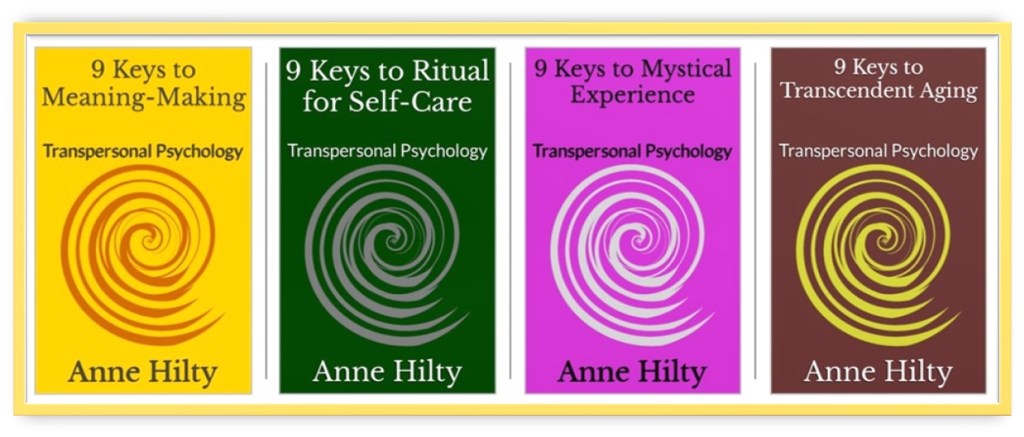
[Excerpted from, 9 Keys to Meaning-Making: Transpersonal Psychology ©2023]
Our 3rd key is body knowledge: accessing personal meaning through the body, in our mind-body relationship. Everyone knows: the body knows.
We’ve all had those gut feelings, instinct and intuition. We all know the experience of emotion held in the body, how getting a massage may make us break into tears. The idea of body wisdom isn’t new to us – and now science has begun to support the anecdotal evidence: the solar plexus as the ‘body-brain’, gut intelligence as it holds sway over our health, cellular memory, memory in connective tissue, and more.
Accessing our cognition, or even our unconscious, isn’t enough; a whole-body approach includes soma as well as psyche. This somatic wisdom can be attained in a variety of ways, broadly in categories of body awareness and movement.
In Asian traditional medical systems, psyche and soma were never separated (Xie et al., 2022), as dualism is a European philosophy; the idea of treating mind and body separately is thus uniquely ‘western’. In fact, a profound disruption between body and mind results in what psychologists term, dissociative disorders (Goldberg, 2020).
The recent work of Monti et al. (2022) demonstrates that the development and maintenance of one’s sense of self or self-concept is closely related to interoceptive influences of the respiratory, cardiac, and gastric systems, certainly internal but not especially mental. This also means, as the researchers posit, that compromises in these bodily systems can lead to disruptions in self-concept – and, it could be further supposed, to one’s presence of meaning.
Trauma and the resultant constellation of stress symptoms provides us with a good example of why cognitive wisdom alone is insufficient. Physical or sexual trauma is a profound insult to the body itself, and the body remembers, in patterns of somatic response well known (Copley & Carney, 2020). Depression can also become an embodied syndrome, which responds well to mind-body therapies (Orphanidou et al., 2023). The psychological manual of disorders refers to this as somatization or conversion disorder, when the psychological issue becomes a very real physical problem – but without a physically treatable cause (Ezra et al., 2019).
I had a longstanding clinical practice in New York that I named, Center for Integrative Health Care. In addition to my psychology degrees, I’d also been trained and licensed in acupuncture, massage therapies, and nutritional counselling, and held certificates in a dozen or so body therapies as well as meditation training. I’ve now lived and worked around the world for 20 years, primarily in NE Asia – and I deeply understand the power of an integrative approach, one which considers psyche, soma, and spirit.
Utilizing somatic therapies in psychology is on the rise as awareness increases among professionals (Kassis & Papps, 2020), and the body’s ability to hold emotion becomes better understood (Greenberg, 2021). The somatic approach has also been applied to both spirituality and psychosocial health (Bhuiyan et al., 2022); a mind-body orientation can lead to greater prosocial engagement and global consciousness as well (Loy et al., 2022).
Somatic psychology includes not only body manipulation and energy therapies but also movement disciplines (Mijaries, 2022), such as Feldenkrais (Allen, 2019), yoga (Bringmann et al., 2021), ballet (Kim & Choo, 2022), or taekwondo (Kim et al., 2015). Energy psychology, too, following on electromagnetic or ‘qi’ practices of acupuncture and kinesiology with methodologies such as Thought Field Therapy and Emotional Freedom Technique, facilitates the somatic source of knowledge and meaning.
While its emergence in traditional psychological approaches is recent, somatic psychology has been a feature of the transpersonal field since its inception more than 5 decades ago (Friedman, 2014). Therapeutic application has been one focus, while another has been that of the physical body as a primary source of knowledge and meaning.
Anderson (2006) developed the Body Intelligence Scale, by which inherent intelligence of the body can be measured; Winton-Henry (2020) and others developed InterPlay, a creative, playful approach whereby adults can access bodily wisdom. Dess (2021) argues that even the phrase ‘mind-body relationship’ does us a disservice, as we are fully embodied humans without hierarchy of mind over body.
Rather than a mere object for diagnosis and treatment, the body holds a ‘central role’ in both meaning-making and identity, according to Orphanidou et al. (2023), and thus, illness can be profoundly disruptive to one’s sense of self and the world. There’s a well-established connection between presence of meaning and physical health, in fact, and Haugan and Dezutter (2022) argue that healthcare professionals should fully support people’s sense of life meaning.
So how can we access what our body knows – its inherent wisdom and intelligence?
.
Exercises:
In a meditative state, quieting the mind by reducing distractions and focusing on your breathing, conduct a slow and methodical body scan. This is not the body-scan found in mindfulness meditation, however, as we seek knowledge. Focus first on your feet, and after establishing strong focus, ask this area of your body for its wisdom; see what, if anything, floats into your mind (e.g., your fundamental support? the direction of your life?). After a short while, shift your awareness to your legs, then hips and pelvis, and so on, up the body. Focus on your torso anterior and posterior separately (i.e., spine and back musculature distinct from abdomen and chest, the latter areas also individually). Be especially aware of areas specifically related to consciousness, such as the sternum, solar plexus, or below the navel. Include shoulders and arms, neck, face, head, crown. Let yourself feel gratitude to your body and its wisdom, before you return to an alert state; in follow-up, engage in some form of reflection (e.g., journaling or contemplation), and ask yourself: how does this newfound knowledge relate to my life’s meaning and purpose?
If physically able, engage in moving meditation. This can be any form of repetitive movement (e.g., jogging, walking, dancing, swimming, rocking, swaying) with a quiet mind, focusing on creativity, innovation or ideas, novelty, new wisdom. Reflect thereafter, on the meaning that creativity and creative thinking bring to your life.
Engage in a guided-imagery meditative session with a focus on body wisdom. While you can find all manner of such online, as previously mentioned the unconscious responds far better to our own voice – so find a script you like, or write your own, and then record it in a slow, soft, hypnotic rhythm. Include a minute of silent lead time at the beginning, to allow you to begin playing your recording and then shift into a quiet-mind, breathing-focused meditative state before your voice recording begins. Afterward, reflect on the details of the experience; did this accessing of your body’s wisdom reveal new sources of meaning, deeper layers of existing or known sources – or more?
Engage in a visualization of personal expansion. Get into a meditative state, with a quiet mind and a focus on slow breathing, distractions minimized; begin by imagining your personhood, the self, your knowledge and awareness, as a walnut-sized sphere of light in your deep mind. When this image is strong, encourage its gradual expansion; first, let the light expand so that it fills your whole brain and cranium. Then, feel it expand into your face, your ears, your throat and neck. Continue on, ever larger, as your sense of self now includes your chest; feel your selfhood as you take each deep breath, in the beat of your heart. Continue, one area at a time, until you feel the full expansion of self throughout your body. Then: sense the knowledge of your body, in its fullness, infused with your selfhood, as one integrated being. Afterward, reflect on how this expansion of selfhood into the full physical body enhances or informs your presence of meaning. [Note: if maintaining your focus in this type of slow and progressive visualization is challenging, you can also make a recording beforehand, guiding yourself in the process as in the previous exercise, and use it as guided imagery rather than visualization. As before: your own voice is the most effective for reaching your unconscious.]
Use your breath. There are many ‘breathwork’ disciplines for using the breath therapeutically. You can also devise your own, for this purpose of accessing somatic knowledge. Again, first get into a meditative state, including a focus on slow, deep breathing. Then, make your focus on breath more specific: focus on the new air traveling down your trachea, expanding your lungs, stretching your diaphragm, enriching the blood that flows into the heart, and the oxygen that is carried by the blood to all tissues, to every cell in your body. When you have a felt sense of this – your awareness fully in and throughout your body, following your breath and the oxygen it delivers – then begin to sense the knowledge, awareness, and memory of all those millions of cells, each one a tiny, primal brain in its own right, breathing with you. Stay with this sense of infused intelligence for a while, and after you gradually emerge from your meditative state, take a few closing deep breaths – and reflect. How does the infusion of breath enhance your sense of cellular wisdom, and how does accessing this infused wisdom affect your presence of meaning?
.
References:
Allen CM (2019). Body Wisdom: Using Feldenkrais to Heal. Alternative and Complementary Therapies 9-11. http://doi.org/10.1089/act.2018.29198.cma
Anderson R (2006). Body Intelligence Scale: Defining and Measuring the Intelligence of the Body. Humanistic Psychologist 34:4, 357-367. https://doi.org/10.1207/s15473333thp3404_5
Bhuiyan N, McNeill LH, Bopp M et al. (2022). Fostering spirituality and psychosocial health through mind-body practices in underserved populations. Integrative Medicine Research 11:1, 100755. https://doi.org/10.1016/j.imr.2021.100755
Bringmann HC, Bringmann N, Jeitler M et al. (2021). Meditation-Based Lifestyle Modification: Development of an integrative mind-body program for mental health and human flourishing. Complementary medicine research 28:3, 252-262. https://doi.org/10.1159/000512333
Copley L and Carney J (2020). Using Gestalt Techniques to Promote Meaning Making in Trauma Survivors. The Journal of Humanistic Counseling 59, 201-218. https://doi.org/10.1002/johc.12145
Dess NK (2021). The End of Disembodied Mind: Fleshing Out Psychology. In, Routledge International Handbook of Theoretical and Philosophical Psychology (pp. 55-77). Routledge.
Ezra Y, Hammerman O, and Shahar G (2019). The Four-Cluster Spectrum of Mind-Body Interrelationships: An Integrative Model. Frontiers in Psychiatry 10:39. https://doi.org/10.3389/fpsyt.2019.00039
Friedman H (2014). Finding meaning through transpersonal approaches in clinical psychology: Assessments and psychotherapies. Journal of Existential Psychology and Psychotherapy 45, 49.
Goldberg P (2020). Body-Mind Dissociation, Altered States, and Alter Worlds. Journal of the American Psychoanalytic Association 68:5, 769-806. https://doi.org/10.1177/0003065120968422
Greenberg LS (2021). Focusing on bodily feelings: When words are not enough. In: Greenberg LS (ed), Changing emotion with emotion: A practitioner’s guide (pp. 143-160). American Psychological Association. https://doi.org/10.1037/0000248-007
Haugan G and Dezutter J (2021). Meaning-in-Life: a vital salutogenic resource for health. Health Promotion in Health Care–Vital Theories and Research 85-101. https://doi.org/10.1007/978-3-030-63135-2_8
Kassis A and Papps FA (2020). Integrating complementary and alternative therapies into professional psychological practice: an exploration of practitioners’ perceptions of benefits and barriers. Complementary Therapies in Clinical Practice 41:101238. https://doi.org/10.1016/j.ctcp.2020.101238
Kim J and Choo S (2022). Mind-body: Positive psychological effects of adult ballet education. Research in Dance Education https://doi.org/10.1080/14647893.2022.2150159
Kim YJ, Cha EJ, Kim SM et al. (2015). The Effects of Taekwondo Training on Brain Connectivity and Body Intelligence. Psychiatry Investigation 12:3, 335-340. https://doi.org/10.4306/pi.2015.12.3.335
Loy LS, Clemens A, and Reese G (2022). Mind–Body Practice Is Related to Pro-environmental Engagement Through Self-compassion and Global Identity Rather Than to Self-enhancement. Mindfulness 13, 660-673. https://doi.org/10.1007/s12671-021-01823-1
Mijares SG (2022). Archetypes, ego states and subpersonalities: an exploration of diversity within somatic awareness. Body, Movement and Dance in Psychotherapy 17:4, 343-355. https://doi.org/10.1080/17432979.2022.2090436
Monti A, Porciello G, Panasiti MS et al. (2022). The inside of me: interoceptive constraints on the concept of self in neuroscience and clinical psychology. Psychological Research 86:8, 2468-2477. https://doi.org/10.1007/s00426-021-01477-7
Orphanidou M, Kadianaki I, and O’Connor C (2023). Depression as an Embodied Experience: Identifying the Central Role of the Body in Meaning-Making and Identity Processes. Qualitative Health Research 0(0). https://doi.org/10.1177/10497323231154210
Winton-Henry C (2020). Grace Operatives: How Body Wisdom Changed the World. In: Bussey M and Mozzini-Alister C (eds), Phenomenologies of Grace. Palgrave Macmillan, Cham. https://doi.org/10.1007/978-3-030-40623-3_20
Xie W, Zhang Y, Wu Y et al. (2022). The significance of dynamic mind-body cultivation of Li – based on archetypal mind-body mutual shaping development theory. Culture & Psychology 0(0). https://doi.org/10.1177/1354067X221120051
 Anne Hilty, PhD