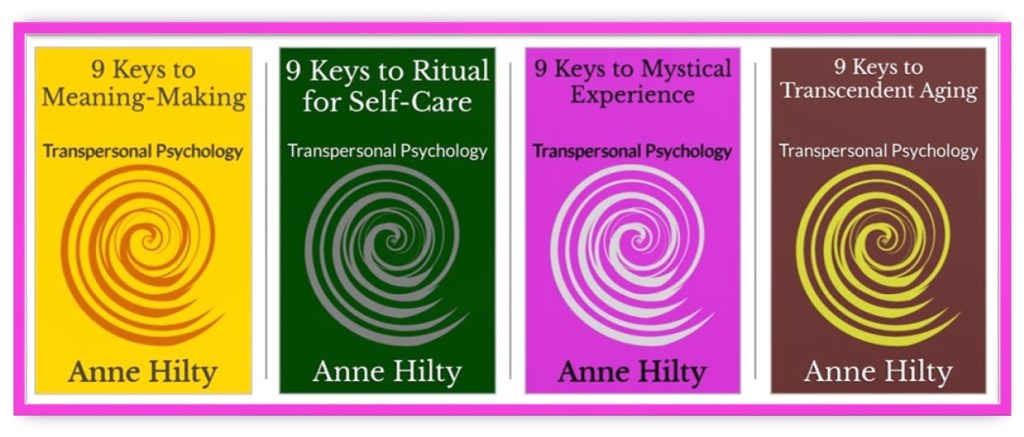
[Excerpted from, 9 Keys to Mystical Experience: Transpersonal Psychology ©2023]
Dreams. We inherently equate them with magic, even as we understand it as our brain’s attempt to defragment and make sense of the day’s input. It may also be that we’re accessing unconscious material, and the unconscious, associated with our primal state or deep and preverbal mind, functions in symbols.
Stories of mystical experience through dreams abound, in every culture and religious tradition. In some, the creation myth includes a deity or other being dreaming the world into existence. Dreaming brings noesis; we learn, experience, and know via our dreams in ways we can’t account for in our waking life.
We remember poignant ones, and some of them repeat. I still vividly and viscerally recall, from half a century ago, a childhood dream in which I was flying with mythical creatures, large fowl with human faces, looking down from above at our home and neighborhood. (I also still recall telling my parents in excitement, only to feel profoundly disappointed in their lack of understanding, when told that it was ‘just a dream’.)
And I’ve two dreams that repeat, each at least once a year for as long as I can recall; in the first, I’m swimming deep in the sea, the water passing through my body, in a state of bliss – and eventually, as the water grows shallow, realizing with a mixture of chagrin and resignation that I must emerge onto the land, and as I begin to do so, the dream ends. In the other, more of a nightmare really, I hear familiar Protestant hymns being sung and am filled with dread that the church of my childhood is grasping me, drawing me back in as if a vacuum, that my ‘escape’ all these years was merely an illusion. Yes, poignant.
Dream interpretation has long been considered a pathway to our unconscious. But how can we utilize the dream state as a key to mystical experience?
In a word: hypnagogia.
Whether you know the term or not, you know the experience: that liminal space between wake and sleep. While it specifically refers to falling asleep, and ‘hypnopompic’ its opposite, the former is more widely used for both. The ‘threshold consciousness’ that this phase represents includes all manner of mental phenomena, from hallucinations to ‘exploding head’ to lucid dreaming and sleep paralysis.
Liminality is sacred in a majority of spiritual traditions – the in-between, the moment of change, the transient and transcendent. This is no different, and we’ll explore lucid dreaming as our key path to the mystical realm. Dreaming brings noesis, that knowledge for which we cannot account in our waking life, sometimes with the added layer of awareness that we’re dreaming (Domhoff, 2023). In lucid dreaming, this is what we seek.
But first: revelatory dreams. Like any other mystical experience, ‘mind-revealing’ in nature, throughout history and across cultures dreams have been conceived as foretelling, the word of some deity or another, or ultimate truth. Supernal dreams come in 4 forms (Irwin, 2020): normative or rational, in which, while they aren’t deeply symbolic or otherwise seem mystical in nature, some truth is nonetheless revealed; mythic or imaginal, such as my childhood flying dream with its mythic creatures; psychic or intuitive, noetic in nature, in which we gain knowledge or insight we didn’t previously know we had; and, the truly mystical or ontological, a spiritual or transcendent experience in which we gain understanding of profound concepts such as the very nature of reality. Naturally, there can be overlap, and they typically occur spontaneously; keeping a dream journal can help us to see patterns and better understand our dream material. But can we engender these revelatory experiences as lucid dreams?
Dream incubation has long been utilized, in various forms. The hypnagogic state has been induced by hypnosis, and by a method very similar to that of lucid dreaming (Ghibellini & Meier, 2023). Lucid dreaming has been studied scientifically just in the past few decades, but the term was coined more than a century ago and its precedent can be found in every major religion, in Hindu scripture dating back more than 2 millennia. Tibetan monks induce it through dream yoga, Christian mystics viewed it as the voice of deity and Augustine identified it more than 1600 years ago as a preview of the afterlife, while Islam considers it the highest form of mystical experience (Mota-Rolim et al., 2020).
Its connection to mystical experience is clear among major religious traditions, and also in the research. In a recent empirical survey study of 471 respondents (Stumbrys, 2021), 95% had experienced lucid dreaming while 65% frequently engaged in same, determined as monthly or more often, and those in the latter category scored higher on several subscales of mystical experience. In a laboratory-based sleep study of lucid dreaming under 4 different conditions (Erlacher & Stumbrys, 2020), a combined wake-up-back-to-bed sleep protocol plus mnemonic technique demonstrated promising results in participants who were not prone to lucid dreaming, the results confirming 4 prior field studies. And in a newly published review of 19 recent studies, Tan and Fan (2023) found consistency across studies, 14 effective methods for induction, and an overall advancement in the research.
The nature of lucid dreaming in accessing noetic experience defines the very term ‘transpersonal’ (Bogzaran, 2020; Irwin, 2020; Stumbrys, 2018) and as such, each has a great deal to contribute to the other. Transpersonal psychology, with its underpinnings in Jungian theory, has been focused on dream interpretation from the field’s inception, especially supernal though not always the lucid dreaming approach. Lucid dreaming is generally seen as an alternate state of consciousness and means of accessing both personal and collective unconscious; it also aligns with both meditation and mindfulness, with the latter taking a passive approach of nonattachment while lucid dreaming is more actively directed (Stumbrys, 2018).
Bogzaran (2020) in particular, a scholar of consciousness studies and expert in the science of dreaming, identifies transpersonal experiences in lucid dreaming as ‘hyperspace lucidity’, which she describes as transpersonal in nature, nondual and nonrepresentational, beyond time and space, and experienced as both extraordinary and impactful – surely also mystical. In her words: “…lucid dreaming can be a threshold to multidimensional aspects of the mind…. The exploration of the depths of the mind through consciousness in sleep is limitless.” (p.67.)
So, how do we use lucid dreaming for achieving mystical experience?
.
Exercises:
We are dreaming in this case not to solve problems or for fun, but for accessing the mystical realm; make that your singular focus prior to sleep, and be as specific as possible.
Setting an alarm to wake yourself in the middle of the night is one especially productive method (if sleep disturbance is acceptable and you don’t have to rise early the next morning!); there are then two approaches: staying awake at least 30 minutes before returning to sleep (as it alters your sleep pattern) – or, saying aloud “I will be aware of my dreams” over and over as you return to sleep.
For lucid dreaming: take a nap. No, seriously. A simple yet effective approach is to engage first in either contemplative meditation or journal-writing on the general topic of mystical experience, or the specific type of experience you wish to have. You can alternately engage in a brainstorming activity of the mind-mapping style, in which you write ‘mystical experience’ in the center of a blank sheet of paper and quickly fill the page with as many associations as possible, drawing lines among them to denote relationships.
Once you’ve focused strongly on your topic, lie down (in the same location; don’t engage in any other activity between your focusing and your napping) and take a nap for 20-30 minutes. Be sure to keep your journal, a notebook, or a note app in your phone nearby, and set an alarm; immediately on waking, sit up and write notes about your dreaming. First write as many keywords as possible, ‘catching’ as much dream detail as you can in this way before it fades; in follow-up you can enhance your keyword list, adding detail, reflecting, interpreting.
Engage in this lucid dreaming exercise at least monthly, but ideally on a weekly basis, as it will continually refine your ability not only to direct your dream to the topic of mystical experience, but to enter the experience itself.
Be sure to maintain a regular practice of meditation. The more often you meditate, and train your brain in this way, the more likely you will be able to achieve lucid dreaming.
It’s also useful to select a particular body part (hands are best) that you focus on strongly as you’re falling asleep; in dreams, try to notice your hands, and you’ll become aware that you’re dreaming by this preset cue.
Keep a dream journal – the more you try to recall and record, the more aware of your dreams you’ll become.
Test throughout the day that you’re perceiving reality and not dream, by noticing details – as this will program your brain to better understand when you’re ‘witnessing’ a dream. Mindfulness practice, of noticing the details around us, is helpful.
References:
Bogzaran F (2020). Methods of Exploring Transpersonal Lucid Dreams: Ineffability and Creative Consciousness. Integral Transpersonal Journal 15, 53-70.
Domhoff GW (2023). The relationship between dreaming and autonoetic consciousness: The neurocognitive theory of dreaming gains in explanatory power by drawing upon the multistate hierarchical model of consciousness. Dreaming 33:1, 1-18. https://doi.org/10.1037/drm0000233
Erlacher D and Stumbrys T (2020). Wake Up, Work on Dreams, Back to Bed and Lucid Dream: A Sleep Laboratory Study. Frontiers in Psychology 11:1383. https://doi.org/10.3389/fpsyg.2020.01383
Ghibellini R and Meier B (2023). The hypnagogic state: A brief update. Journal of Sleep Research 32:1:e13719. https://doi.org/10.1111/jsr.13719
Irwin L (2020). Supernal Dreaming: On Myth and Metaphysics. Religions 11:11:552. https://doi.org/10.3390/rel11110552
Mota-Rolim SA, Bulkeley K, Campanelli S et al. (2020). The Dream of God: How Do Religion and Science See Lucid Dreaming and Other Conscious States During Sleep? Frontiers in Psychology 11:555731. https://doi.org/10.3389/fpsyg.2020.555731
Stumbrys T (2018). Bridging lucid dream research and transpersonal psychology: Toward transpersonal studies of lucid dreams. Journal of Transpersonal Psychology 50:2.
Stumbrys T (2021). The Luminous Night of the Soul: The Relationship between Lucid Dreaming and Spirituality. International Journal of Transpersonal Studies 40:2:6.
Tan S and Fan J (2023). A systematic review of new empirical data on lucid dream induction techniques. Journal of Sleep Research 32:3, e13786. https://doi.org/10.1111/jsr.13786
 Anne Hilty, PhD