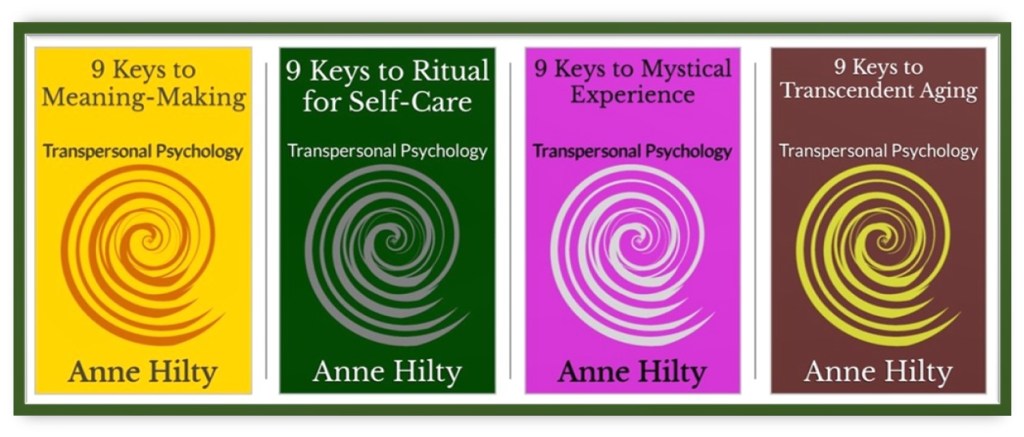
[Excerpted from, 9 Keys to Ritual for Self-Care: Transpersonal Psychology ©2023]
In our 4th key, we apply ritual to the realm of the ancestors.
Many cultures and religions have ways of honoring and remembering their dead. This provides the living with a deep sense of rootedness and continuity, as we consider the countless blood ancestors who have gone before us; according to one model, ancestor-descendent relationship has promoted altruism and cooperation among family groups across cultures, thereby serving a greater purpose for humanity (Clark & Coe, 2021). As we saw in our previous key, ancestor rituals help us in processing our grief, by turning our focus toward consolation of the dead, and in resolving our death anxiety, by acknowledging that we, too, will one day join the ancestors and become one of them. It gives us a sense of being ‘eldered’, no matter what our own age, as the ancestors are always there, watching over us. Most of all, in the human existential loneliness, it helps us to understand deeply that we are never alone – that ‘10,000’ ancestors walk with us at any given time.
There are also several ways to conceptualize ‘ancestors’, as found across cultures and religions. Beyond blood or genetic ancestry, we think of ‘the mighty dead’ or ‘potent dead’, ancestors of spirit who are not related to us but either impacted us personally or made great contribution to humanity. In many cultures, ancestors of land or of place represent another interpretation, those who lived before in the place or land where I now live. And finally, we find traditions for ancestors of hearth – another place concept of ancestors, those who lived in my home before I have and are now deceased, or archetypally, the very concept of home.
Some further view deities as ancestors, particularly true in shamanic traditions which consider their many gods as having once been in human form and as ancestors of all those who worship them. (Shamans even view their magical or sacred regalia as ‘ancestors’, communicating with them and storing them when not in use on a special altar in either the shaman’s home or local shrine.)
So how can we use ritual to facilitate ancestor veneration?
In my morning opening and evening closing rituals mentioned earlier, I include ‘ancestors of blood and spirit, land and hearth’. I have shrines set up for each in my home – photos and objects of family on the ancestors of blood shrine, along with candles, offerings, and more; nature objects found locally on the land ancestors shrine, and so on, including a small glass of water on each which I maintain as a regular offering.
At the dark moon each month I create a ritual to ancestors – of late, an especially receptive one; I lay an altar to them collectively, large black candle and frankincense resin burning, food and wine offerings. After preparation and opening, a calling and stating of purpose followed by induction of altered state of consciousness, I sit in an easy chair nearby, gaze with soft focus into the candle’s flame, and state aloud: “I’m listening.” Staying in this state for a while, insights arise, which I reflect upon following the ritual’s end.
I’m now contemplating, as I will soon enter elderhood as mentioned, how I want to prepare to become a good ancestor – and expect my ancestral rituals to become ever more poignant as I age.
Ancestor veneration is extremely important in Northeast Asia (Luyao, 2022), where I lived for the better part of 2 decades, and indeed, throughout the Asian continent; China and India place especially high priority on the ancestral realm, directly associating self-transcendence with relationship to one’s ancestors (Choi et al., 2022). It’s also embedded in traditions across Africa (Ushe, 2022) where they’re typically connected to sacred place and sought for mystical experience (Mahohoma & Gundani, 2020), and among other indigenous peoples the world over. Modern pagans in Europe and North America often include ancestral rituals in their practice as well (Uzzell, 2018), while Robinson (2021) has proposed that blood ancestor research itself, such as genealogy work or visiting historic family sites, be viewed as sacred ritual.
.
Exercises:
For clarity: do you wish to acknowledge ancestors of blood, spirit, land, and/or hearth? One, or all?
For ancestors of blood: do you know your genealogy? Or at least, back 3-4 generations (all family lines)? Consider what you’ve inherited from them, what they’ve experienced (as you know), including timelines – did they live through a war, for example?
For ancestors of spirit: who has helped to shape you? Who has been significant to your profession, personal and/or cultural development, spirituality? To your society, to all of humanity? Consider their contributions, how this has affected you and/or the world – and what you’d like to ask or learn from them.
For ancestors of land: what do you know about the land / nature nearest your home? Learn more – about the trees, plants, animals, birds that live there. Know it intimately. What relationship can you cultivate? How can you care for this land on which you live?
And, for ancestors of hearth: do you know anything about previous occupants of your home? Can you feel the essence, the ‘spirit’, of the home? What relationship can you build – with your home, its core essence, how you feel about living there, the archetype of ‘home’ and all that means to you? How can you honor this?
Consider creating an ancestral shrine, which you maintain in some simple, daily – even interactive – way.
Hold a monthly or regular ritual for and with your ancestors. Design your ritual (including some method to alter consciousness, and visualization / guided imagery as appropriate), prepare as needed, imagine it from start to finish – and afterward, reflect in some way and integrate into your daily life – as always.
The simplest form, yet often profound, as described earlier: create your atmosphere, sit comfortably, quiet your mind, think of your ancestors, and state aloud: “I’m listening.” Continue to sit quietly for a period of time, maintain focus, see what insight arises. When the ritual comes to its natural end, close your ritual and reflect.
This form can be used for a variety of ancestral rituals: with all ancestors, with the archetype of ‘ancestor’, for each category (blood, spirit, land, hearth) individually. If you have individual blood ancestors whom you’d like to honor, consider holding your ritual on their death day, as in a range of traditions worldwide; far from morbid, this is the day on which they entered the ancestral realm: a graduation.
Honor; listen; be eldered; be grateful.
References:
Choi SH, McClintock CHY, Lau E et al. (2022). The impact of perceived relationship to ancestors on the association between self-transcendence and psychopathology: A cross-cultural examination. Transcultural Psychiatry 0(0). https://doi.org/10.1177/13634615211049072
Clark KJ and Coe K (2021). The interdependence of ancestors and their descendants. Religion, Brain & Behavior 11:3, 281-293. https://doi.org/10.1080/2153599X.2021.1922494
Luyao Z (2022). The Practice and Function of Ancestor Worship in Chinese Society. Praxis, Folks’ Beliefs, and Rituals: Explorations in the Anthropology of Religion, 48-56. https://doi.org/10.9734/bpi/mono/978-93-5547-925-9/CH5
Mahohoma T and Gundani PH (2020). Experiencing the Sacred. Studia Historiae Ecclesiasticae 46:1. https://doi.org/10.25159/2412-4265/3363
Robinson R (2021). Pilgrimage and Purpose: Ancestor Research as Sacred Practice in a Secular Age. Genealogy 5:4, 90. https://doi.org/10.3390/genealogy5040090
Ushe UM (2022). God, Divinities and Ancestors in African Traditional Religious Thought. An African Journal of Arts and Humanities 3. https://doi.org/10.4018/978-1-7998-4595-9.ch002
Uzzell JS (2018). Gods, Wights, and Ancestors: The varieties of pagan religious experience at ancient sacred sites. Journal for the Study of Religious Experience 4:1, 64-80.
 Anne Hilty, PhD