Dr. Carl Jung, a Swiss psychiatrist of the early 20th century and initially a protégé of Freud, was a pioneer in the emerging scientific study of human psychology. Interested in … Continue reading The Witch & Dr. Jung
Dr. Carl Jung, a Swiss psychiatrist of the early 20th century and initially a protégé of Freud, was a pioneer in the emerging scientific study of human psychology. Interested in … Continue reading The Witch & Dr. Jung

Three rescue workers kneel, heads bowed, before the colorfully robed shaman as she dances around them, waving her knives, their long white ribbons wafting through and cleansing the air as … Continue reading Shamanism, Folk Psychology
[Introduction, Ecopsychology, Ecospirituality ©2024, by Anne Hilty]
A long walk along the coast of New York’s Fire Island after a ‘white hurricane’, a fierce January blizzard that tragically, and near-mythically, tossed thousands of starfish up into the dunes. A canopy walk along suspended bridges of wood and rope, high up in Costa Rica’s pristine Monteverde cloud forest. Trekking one of Hong Kong’s outlying islands, as a python slithers across my path, wild boar rustle in the shrubbery, and green sea turtles nest on the beach at its southern tip. In the sea with traditional free-diving haenyeo, many of them elderly grandmothers, off the coast of South Korea’s Jeju Island. Walking meditation on one of Istanbul’s smallest islands, with its black bull, white horse, and hooded crows at the peak alongside ruins of a Byzantine monastery, pollinators at every flower, fungi on the forest floor, and one ancient olive tree. I am refreshed, rejuvenated, reborn.
“My generation doesn’t have any future, because of climate change. How can I care about anything anymore? What’s the point?”
Struck hard by the words of this 12-year old girl, brought to me by her parents for counseling, I instantly sensed my own climate distress, and took a deep breath as I gathered my thoughts.
“I can’t promise you a future,” I replied. “No one can. But I can tell you a couple of things that might help: I still have hope, because a whole lot of people around the world are working on this problem, as enormous as it is. And, my love for nature brings me sadness at the damage we’ve caused … and also great joy, in the deep relationship I have with the natural world. Could we maybe explore this together?”
We live in an era fraught with climate-related anxiety and despair. At the same time, we see a trend of all things ‘eco’, seemingly everywhere we look.
So what is ecopsychology? Is it just another fad? And ecospirituality – merely a New Age idea?
No, and no.
There’s a goodly amount of intersection between these terms, and we’ll explore that once we’ve looked at each one separately. Suffice it to say, for now, that ecopsychology was developed as a subspecialty of depth psychology more than 3 decades ago, when environmental concerns were surely raised but we weren’t yet talking much about global warming, much less imminent ecosystems collapse. Ecospirituality emerged even earlier, conceptually in the 1960s and in the scientific literature by the 1980s – and organically, in indigenous cultures around the world from earliest times. (More on that soon.)
These two topics and their intersection are at the very foundation of my own life. My heritage is one of Swiss Anabaptists, Amish (maternal) and Mennonite (paternal), who immigrated to the US in the 18th and 19th centuries to escape religious persecution as heretics. Referred to as stillen im lande, the quiet ones of the land, in their distinct form of German, they live in separatist agrarian-based communities. My near ancestors broke away from these communities yet remained farmers, and in my childhood, I was able to spend a goodly amount of time on family farms. My father, his own childhood in a farming environment, frequently took us camping, hiking, fishing, and other outdoor activities. I developed a deep love for the natural world, my primary source of psychological wellbeing.
By adolescence, keen on academia, I wanted nothing more than a quiet spot with a stack of good books – and discovered the Transcendentalists of 19th century New England (US): Thoreau, Emerson, and the like, one of the core principles of which was the divinity of nature. This resonated powerfully with me, and I began separating myself from the monotheistic religion of my childhood in order to seek forms of ecospirituality instead.
In early adulthood, this morphed into a practice of nature-based spirituality, environmental activism, and vegetarianism. In my professional development, I gravitated to East Asian health practices such as traditional Chinese medicine and Japanese shiatsu, alongside transpersonal psychology, all of which is very much in keeping with these principles; in such there is no separation of body, mind, and spirit, nor between self and other, nor of human from nature. By mid-adulthood I was living in NE Asia and studying shamanism, Buddhism, and Taoism, while traveling the world and exploring the natural environment in all its many variations.
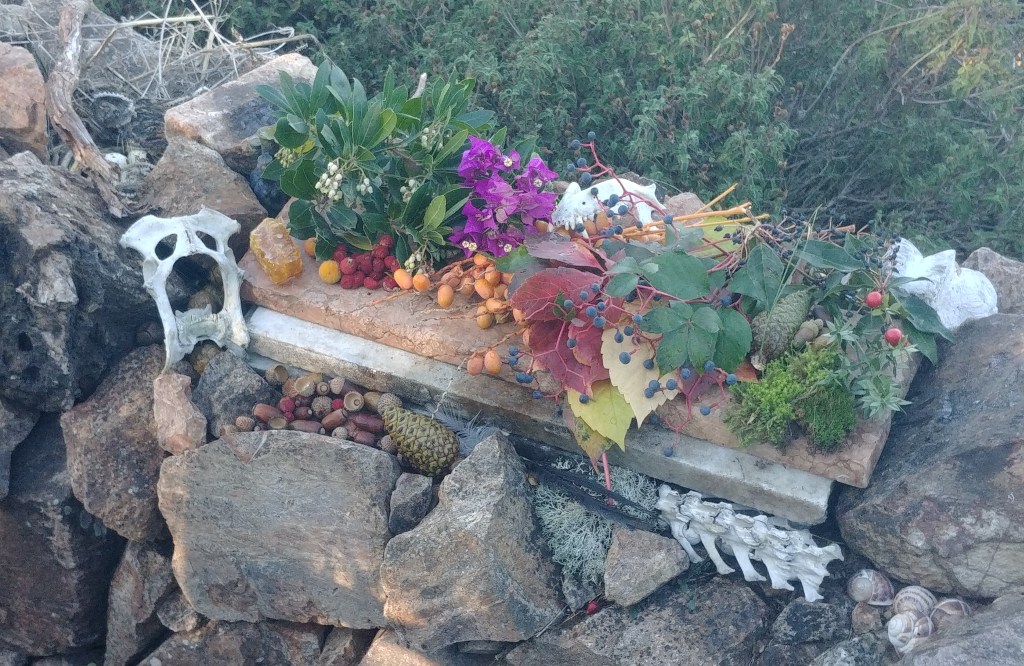
I have just stepped into my elderhood, a stage burgeoning with the potential for deep psychological and spiritual development, and the natural world for me represents a significant source of meaning. In my home I maintain a shrine to my Ancestors of Land, conducting a brief ritual to same at both open and close of every day. I immerse myself in nature each week as I travel by boat to a nearby island and trek alone for hours, meditating and honoring the land spirits. And I am gravely concerned about the impending ecological crisis.
Ecopsychology, as we will soon see, is one of meaning-making, of addressing climate-related anxiety and despair, and of time spent in nature as a source of mental health and resilience. Ecospirituality allows one to look at manifestations of nature and see spirit, and deity – or a meaningful metaphor or archetype of same. These underlying principles intersect to form what has been called deep ecology, in which the individual resonates with the natural world, and indeed, ceases to hold a view of ‘individualism’ at all, but one of universal interconnectedness instead. With this naturally comes a deeply felt sense not only of meaning, and of wellbeing, but also of responsibility.
Shall we begin?
Bowing deeply many times in succession during my stay at one of Korea’s Buddhist temples, I considered the rise at astronomical dawn for first prayers, the walking meditations in nearby groves, the pure and natural foods, the temple’s remote setting on a mountaintop. When we are in the midst of nature, the lead monk told me, and we consume the foods of nature and drink its tea, breathe in the early morning light and wash in the nearby pond, only then are we close to a state of harmony. Our minds are eased, we are healed of all our anxieties and sadnesses, and we are as we were meant to be. When we in turn care for the natural world, understand that this is our responsibility, then we achieve true wellbeing.
[excerpted from, 9 Keys to Ritual for Self-Care: Transpersonal Psychology ©2023]
Ritual adds meaning to one’s life.
The presence of meaning has multiple benefits on one’s wellbeing, mental and physical health, and quality of life (Haugan & Dezutter, 2021) – so we do well to pursue it; ritual is one way of enhancing the meaning of even mundane activities, and of infusing one’s life with a greater sense of meaning, and of the sacred.
The relationship of religious rituals and the construction of meaning is obvious (Nugteren, 2019); those found in nature-based or other forms of spirituality also enhance presence of meaning (Sonnex et al., 2022). Secular rituals around birth, death, and other life passages clearly add meaning to our lives as they help us to acknowledge and share emotions (Wojtkowiak & Mathijssen, 2022). Even those conventional rituals, or shared patterns of behavior, to mark holidays and other special events provide yet another social source of meaning (Shoham, 2023).
Indirectly, construction of personal meaning is the purpose of all ritual. It contributes to a ‘handcrafted life’ in which we design and direct, to the degree possible, the life that we’d like and the self that we hope to be. We use personal ritual, spiritual or secular, to construct meaning and give purpose to our own life, just as religions use ritual for the same purpose. The use of ritual can also add a layer of significance to an otherwise routine activity.
Each morning as I ‘open my day’ with my 5-minute ritual, and do the same at close of day, I’ve given a frame to my day that injects it with a sense of the sacred. When I go weekly for a long solo trek on a nearby island, I do so as a form of ritual in which I embrace and am embraced by the natural world, as we are one. The ancestor shrines surround me throughout the day, and when I listen, I learn. Seasonal and full moon rituals connect me more deeply to the rhythms of the earth, while rituals for healing or for facilitating a sense of wholeness and integration provide me with a framework for personal growth, and those of honoring life passages provide milestones by which I know my life to be significant. Meaning-making.
A few years ago, I attended a shamanic ritual held for a community of traditional free-diving fisherwomen who had lost one of their number at sea; as the shaman stood at the sea’s edge, calling the dead woman’s spirit to return and exhorting the dragon god of the sea to let her go, I was struck by the poignance of the moment and the depth to which the woman’s community mourned her – as they also processed their own fears of a similar watery death.
Some few years before that, I was in another shamanic ritual, this time in the steppe of Eastern Siberia among the Buryat or ethnic Mongolian community there. An extended family group had had too many misfortunes; they hired a shaman to conduct an all-day ritual for and with them. As we gathered in the foothills, away from society, multiple family members present, and engaged in a full day of rites including the traditional sacrifice of a ram, the significance for this family was evident in the relief on all their faces by day’s end.
In a group ritual 20 years ago, I unexpectedly found myself in deep mourning for my beloved grandmother who was not yet dead but severely ill, sobbing and calling for the spirit world to take her because she was ‘so broken, so broken’. She had many ailments which rendered her debilitated, and was ready to go; 5 weeks later, she directed her own death with a hospice doctor’s help, to which I was a witness.
Meaning. A life of ritual is infused with meaning.
We can develop personal rituals to help facilitate meaning in our lives. Perhaps you create a ritual within which you ask yourself, in this special and set-apart context, “What is the meaning of my life?” or, “How can I enhance meaning in my life?” or even, “When I finally come to the conclusion of my life, will I be able to say, it was a life well lived?” Rather than answering, you listen – to that inner voice, to the spirits or ancestors, to your deity, as you choose.
We may also create ritual to better identify and understand the ways in which our lives already hold meaning. We can enhance these sources of meaning by creating rituals to honor them. And we can use ritual to set goals related to our purpose as we see it, and to help us achieve them.
So, in addition to the meaning that ritual imbues when conducted for any purpose, we can use ritual specifically in the search for and to strengthen the presence of personal meaning.
.
Exercises:
As ever, we begin with a process of clarity. In meditation, contemplation, journal-writing, mind-mapping, or similar, ask yourself: what are my current sources of meaning? How can I strengthen any of these? What do I hope to add? Perhaps even the more existential question, if so inclined: what is meaning?
Even if using another method for clarity initially, be sure to engage in meditation for deep insight. You can use multiple methods over a period of days, in fact, as this is a complex topic.
Design your ritual (including some method to alter consciousness, and visualization / guided imagery as appropriate), prepare as needed, imagine it from start to finish – and afterward, reflect in some way and integrate into your daily life – as always.
In your altered state or quiet mind, visualize current sources of meaning in your life one by one; envision acknowledging, celebrating, and strengthening each in turn. Then, visualize other sources you’re aware of and would like to have, but are not yet integrated into your life (do you imagine an intimate partnership or marriage? birth of a child? change in career? new spiritual path? mentoring? volunteering to help others in need?); envision as fully as possible, embracing, integrating.
Use guided imagery to travel to a ‘sacred’ and/or natural place, meet a Wise One there, an ancient woman or man, sit with her/him for a while and ask for guidance. Or: visualize going to the ‘source’ of all knowledge – a deep well, a brilliant light, the cosmos, your deity of choice – and ask for insight.
We can create more active ritual too, in that we open our ritual, then engage in activities of meaning-making – song, dance, perhaps poetry-writing or storytelling, acts to honor the sources of meaning in our lives –any kind of ceremony that feels significant to you, to strengthen our sense of a meaningful life.
References:
Haugan G and Dezutter J (2021). Meaning-in-Life: A Vital Salutogenic Resource for Health. In: Haugan G and Eriksson M (eds), Health Promotion in Health Care – Vital Theories and Research. Springer, Cham. https://doi.org/10.1007/978-3-030-63135-2_8
Nugteren A (2019). Introduction to the special issue ‘religion, ritual, and ritualistic objects’. Religions 10:3, 163. https://doi.org/10.3390/rel10030163
Shoham H (2023). Deep conventionality, or, tracing the meanings of conventional rituals. American Behavioral Scientist. https://doi.org/10.1177/00027642221145025
Sonnex C, Roe CA, and Roxburgh EC (2022). Flow, liminality, and eudaimonia: Pagan ritual practice as a gateway to a life with meaning. Journal of Humanistic Psychology 62:2, 233-256. https://doi.org/10.1177/0022167820927577
Wojtkowiak J and Mathijssen B (2022). Birth and Death: Studying Ritual, Embodied Practices and Spirituality at the Start and End of Life. Religions 13:9, 820. https://doi.org/10.3390/rel13090820
 Anne Hilty, PhD